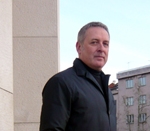
The Multimedia artist Vladimir Frelih informed us, as well as Culture.net that he as a “winner of the Kulturvermittlung Steiermark Scholarship, presents his works at the solo exhibition Grosse Schritte kleine bewegung from 4th November to 20th December in Graz.
Born in Osijek in 1963, studied Sculpture/Installations at Kunstakademie Düsseldorf (Germany). His tutors were Professors Hoover, Paik and Jatel. He became a Master Grade student in 2001 and attended tutorial classes by Professsor Jatel. 2008 Multimedia Lecturer at the Osijek Academy of Fine Arts and leader at the Department of Art. From 1994 his work has been shown nationally and internationally at exhibitions and events.
He uses a variety of art media and techniques with reference to their structural faults and advantages. His art work has received a number of awards and scholarships and is on display in several contemporary art collections and museums. Currently based in Osijek and Düsseldorf.”
Curator of the Museum of Modern and Contemporary Art Rijeka Sabina Salomon introduces a famous international artist Mirko Ilic at The Museum of Contemporary Art Vojvodina, Novi Sad on 25th October – 14th November, 2011.
“The exhibition THE PEACE WORKS – Mirko Ilic – Retrospective: comics / illustration / design / multimedia 1975-2011 is an artistic event that will give the audience a chance to get acquainted with the previous works of this author. Mirko Ilic published his first works in 1973, and since then has been publishing comics and illustrations in magazines, such as Omladinski tjednik, Modra Lasta, Tina, Pitanja; he has become the art and comics editor of the students’ magazine Polet in 1976. He helped to organize an informal organization of the comic book creators Novi kvadrat (The New Square), that has been widely connected to the Novi val musical movement in Zagreb.
In 1986 he left Yugoslavia and went to New York “with $1,500 in the pocket and no idea what to do upon getting there.” He soon started publishing his illustrations in Time, The New York Times, Los Angeles Times, Wall Street Journal, and many other prominent and influential newspapers and magazines. In 1991, he became art director of Time International, and the following year he became art director of the op-eds in The New York Times. In 1993, Ilic became one of the co-founders of Oko & Mano Inc. graphic design studio, and in 1995 he founded Mirko Ilic Corp., a graphic design and 3-D computer graphics and motion picture title studio. In 1998, he created the title sequence for the romantic comedy You’ve Got Mail.”
The prestigious American media “The Village Voice” presents Croatian curatoring of Branko Franceschi’s exhibition “Tune in Screening: Psychodelic Moving Images from Socialist Yugoslavia 1966-1976” as the best or Top Arts story in New York at the moment.
A journalist R.C. Baker explains: “Post-World War II Yugoslavia threaded a Cold War needle between the Soviet Union’s Communist hardliners and the West’s hedonistic capitalists. This national schizophrenia perhaps explains the fantastic flowering of proto-MTV films and conceptual objects created by the Slovenian avant-gardists known as the OHO Group. In 1968, an OHO founder, Marko Pogacnik, crafted a puzzle by slicing up a photo of the Rolling Stones and gluing the pieces to a dozen matchboxes. In a recent interview, the artist summed up his affecting object (which opens the exhibition): “In the same way that matches appear when one needs to build the fire, pop culture ignited our imagination.”(…)”
Although the journalist Baker writes about the cultural moment of the analysed period in the exhibition, we think that he missed so much regarding philosophy and curatorial capacity.
‘Tune in Screening: Psychedelic Moving Images from Socialist Yugoslavia”, the exhibiition curated by Branko Franceschi opens on 2nd October (6-9pm) in Stephan Stoyanov Gallery in New York. The exhibition is on view till 30th October.
Between 3rd and 30th October Franceschi will open a Virtual Museum of Avant-garde Art’s Overseas Headquarters located in New York’s organization Residency Unlimited. The project will function as a temporary office for meetings, open talks, and plan making regarding the museum and possible future collaborations.
Branko Franceschi is a director of the “Virtual Museum of Avant-garde Art” http://www.avantgarde-museum.com, based in Zagreb, Croatia. The Virtual Museum of the Avant-garde aims to compensate the shortcomings of virtual reality through the direct exchange of knowledge on Southeastern Europe’s avant-garde movements to professionals, artists, students and the general public of New York. “The screening focuses on experimental film production and rock music created in Yugoslavia from 1964 to 1974. The materials all indicate a degree of openness and permissiveness that characterized Yugoslavia’s brand of socialism when importing and incorporating pop and alternative culture from the West. This cultural exchange influenced local society, arts, and, especially, Yugoslavia’s lifestyle and popular culture.”
Trained as an Art Historian at the University of Zagreb, for more than 20 years Franceschi has initiated and curated numerous exhibitions of contemporary art for exhibition venues in Croatia and beyond. Membership: AICA (AICA Croatia President), ICOM, CIMAM, DPUH, Advisory Committee of Art in General, New Media Commission for the Ministry of Culture Republic of Croatia (President), Gallery and Museum Program Commission for the Municipality of Rijeka (President).
The programme is realized with the support of CEC Artslink www.cecartslink.org, as well as Croatian Ministry of Culture, and the activity of “Virtual Museum of Avant-garde Art” is assissted by The Town Varazdin.
International Interdisciplinary Symposium PHILOSOPHY OF MEDIA – Issues of founding, establishing and/or revelation, will be held on the Croatian island Cres between 16-18 September, 2011. Media-via portal editor M.A. Vesna Srnic is invited to present her papers “Glocal Multimedia Art” at the symposium, organised in the year in which we celebrate the centenary of the birth of Marshall McLuhan.
In front of Program comitee PhD. Divna Vuksanovic (Serbia) and PhD. Sead Alic (Croatia) stressed: “We live in a time of media intercession, networking, virtual worlds, a growing impact of mass media on politics, culture, human life, experience, or even opinions as such. We exist in a time when the immersion into the world of the mass media reminds us of the fact that we as human beings throughout history have been determined by some sort of media and that only the modern preoccupation with the (mass) media has given rise to an awareness of (partial or total) oblivion of media intercession,especially during times of oral communication, written and print form.” (…) “In this sense, the philosophy of media co-opts the scientific research of linguistics, psycholinguistics, media theory, the theory of special art, knowledge of techniques and technologies, research psychology, medicine, phonetics, cultural and visual studies, and other science disciplines, theoretical knowledge and practice experience.”tENrNp4O_ZE
Symposium sponsors are Ministry of Science, Education and Sports of the Republic of Croatia, Croatian National Tourist Board, Town of Cres and Hotel Kimen Cres.
A three in one postgraduate study: acting, media in which the acting occurs, and culture created by acting was founded at the University of Rijeka by the internationaly famous actor Rade Serbedzija.He also founded the Ulysses Theatre in 2000 in Brijuni, where he directs and acts in most plays.
The postgraduate programme was established on December 14th, 2010 by the Senate of the University of Rijeka as a two-year course for specialising in acting, media and culture field of research. Anyone can enroll into the programme, provided they have a valid university degree and have passed the admissions exam. The programme lasts two years (four semesters) during which theory and practice intertwine through courses such as Voice, Acting, Dramaturgy of Performance, Reading Drama, Characteristics of the Cultural System, Actor as Musician, Philosophy of Arts, Actor and Choreography, Postdrama Theatre.
Main aims are training the students to become critics, theoreticians, scientists that have empirically tested methods and challenges of acting process, as well as interdisciplinarity, interactivity and internationality as the policy of the programme. Part of the courses will be held in English, involving collaborators and professors from foreign leading universities and art schools, such as Nigel Osborne, Reid professor of Music at the Edinburgh University; Staša Zurovac, director and choreographer; Nikola Petković, writer; Snježana Prijić-Samaržija, philosopher; Robin Carr (University of Southern Mississippi) and Deborah Kinghorn (University of New Hampshire), masters of Lessac method for voice and acting; Elvio Baccarini, philosopher; Karpo Godina, film director and DoP, and many others.
From June through November famous Newton’s polaroids of mainly erotic fashion photo shoots can be seen in Berlin at his Foundation. For the first time ever, over 300 works based on the original Polaroids offer a comprehensive overview of this aspect of Newton’s oeuvre.The exhibition is thus a look into the sketchbook of one of the most influential photographers of the 20th century.
“Helmut Newton used the technology intensively starting in the 1970s, especially for his fashion photo shoots. As he once described in an interview, this satisfied his impatient urge to want to know immediately how a certain situation would look as a photograph. In this context, the Polaroid acted as an idea sketch in addition to testing the actual lighting situation and image composition.”
On Wednesday, 27 July through August, the filming of Goltzius and the Pelican Company by British art film director Peter Greenaway began in Zagreb.The creative part of the crew includes around 60 Croatian members with filmmaker Zoran Sudar as the best Croatian co-production first assistant director with international reputation.
“The story takes place in 1590, at the time when Dutch painter Hendrik Goltzius negotiated in a castle on the Rhine with the rich Alsatian nobleman Margrave to ensure him the funds for a print press. Goltzius wished to print eroticised versions of illustrated Old Testament tales. The nobleman’s castle, enthralled with Goltzius’ seductive tales, drenched in the motifs of incest, adultery, and rape, slowly sinks in the trap of aroused lust, and consequentially in a conflict with religious circles.
The role of Goltzius is played by Dutch actor and poet (the current Dutch Poet Laureate 2009-2012) Ramsey Nasr, and the film also stars American actor F. Murray Abraham (Amadeus, All the President’s Men, Scarface), French actress Kate Moran, Italian actor Pipo Delbono, and Croatian actors and actresses Nada Abrus, Katja Zubčić, Goran Grgić, Enes Vejzović, Duško Valentić, Milan Pleština, Tvrtko Jurić, Vedran Živolić, Samir Vujčić and Goran Bogdan.” The creative part of the crew includes around 60 Croatian members with filmmaker Zoran Sudar (The Last Will ) as the best Croatian co-production first assistant director with international reputation (Anton Chekhov’s The Duel,White Lightnin’, The Hunting Party, The Peacemaker“.
“Peter Greenaway is the author of one of the most exciting film works of today. Film devotees remember him by the extraordinary classic The Cook the Thief His Wife & Her Lover from 1989. Since then he has acquired the cult status thanks to his films The Draughtsman’s Contract (1982), The Belly of an Architect (1987), and Drowning by Numbers (1988). His digital analysis of the painting The Wedding at Cana by the mannerist painter Paolo Veronese was screened at the Venice Biennale in 2009. A New York Times critic called it one of “the best art history classes of all times””.
Motovun Film Festival runs from July 25 to July 29 for the 13th consecutive year offering some of the best cinema productions from around the world. This year the festival premiers a film by Wim Wenders dedicated to Pina Bausch.
Motovun Film Festival is entirely dedicated to films made in small cinematographies and independent productions, films that broke out through their innovation, ideas, and the power of their stories. In everything, except for the ambition and the quality, Motovun wants to be a small festival showing small films, small in the warmest sense od the word.
Motovun Film Festival is a five-day film marathon in which film screenings alternate from 10 a.m. until 4 a.m., with evening outdoor screenings and daily screenings in theatres. Festival program consists of around 70 titles from all over the world, from documentaries to feature films, from shorts to long forms, from guerilla made films to co productions. The only criteria in their selection is that they fit in the open-minded atmosphere of the festival with their innovations. This year the festival is being held for the twelwth time.
Dr W.J.T. Mitchell from the University of Chicago, was a key-note speaker at the event Visual Studies Today – The Power of Images, which was organized by the Center for Visual Studies, Zagreb from 7th to 8th November 2013, as well as at the conference Visual Studies as Academic Discipline . Dr Mitchell is the most famous authority of visual studies in the world. (Schedule) Dr Mitchell’s talk was titled “Seeing Madness: Insanity, Media, and Visual Culture” and it raised two questions:”1) Is it possible to “see madness” or to represent it visually with any kind of certainty? 2) What motivates the desire to see madness, to put it on stage, or to capture its variable manifestations in visual images?” Examples were drawn mainly from photography, operatic spectacle, and cinema.
NGO “Culture, Media and Education” president and Media-Via editor Dr Vesna Srnic attended the lecture and because of the lack of time asked Dr Mitchell a question in writing, that he will possibly answer.
This is a question of Dr Srnic:
“In Critical Inquiry, in 1991st, you interviewed famous American conceptual artist Barbara Kruger. When you elaborated the relation between Image and Word, as well as about Gender and Embodiment, you provoked Barbara Kruger with this /quotation:
„You can go back to the Old Testament to find sentiments like “a silent woman is the gift of God.”
and KRUGER said: Oh, let me write that down.“ /unquote (Critical Inquiry, 1991, p. 445)
I think this is a very interesting moment in that interview, because of several possible interpretations: on charismatic, feminist, Leftist level Kruger was understandably surprised, although she should have known the point of that religious view, and did not mock; another Rightist level is well known for its meaning as the mystical power of silence.
What I would like to ask you is if you can see the theses of the third meaning in the phenomenology of Time and Space as Here and Now, in the performative middle way, thus artistically rejecting Gender differentiation, rejecting Images and Words completely, as well as Leftist and Rightist positions and oppositions?
Is this „spinning wildly or standing still“ significant Spiritual Embodiment for you and can be seen as, although marginal, the rejection of the Madness?”
MARK TRIBE: ‘THE DYSTOPIA FILES’ (Zagreb, June 9th – July 9th 2011), ‘Performance, mediation and public sphere’, workshop and public lecture
„The Dystopia Files“ (A dystopia – from Ancient Greek: δυσ-, “bad, ill”, and Ancient Greek: τόπος, “place, landscape” is the idea of a society in a repressive and controlled state), at g-mk is the newest iteration of Mark Tribe’s ongoing project, which recontextualizes the history of demonstrations in the US. The artist had gathered an archive of protest footage, which serves as a base for creating site specific video installations in gallery and museum spaces. The work tackles on a set of questions about power relations, spectatorship, image manipulation, participation, interaction and political engagement. The relationship between these issues and recent curatorial practices will be discussed during the workshop held by Mark Tribe. In a talk following the workshop, Mark will present his multimedia artistic practices, including his previous acknowledged projects such as Rhizome and Port Huron ( The Port Huron Project is a series of reenactments of protest speeches from the New Left movements of the Vietnam era). The exhibition is curated by Željka Himbele Kožul.
Zagreb (7-21 May 2011) will be a host of the International 4th Subversive Film Festival. Subversive Film Festival is no ordinary, competition film festival. It is first-of-a-kind hybrid of film/video and critical theory, aiming to explore and understand recent cultural history.Film program in cinemas Europa and Tuškanac will be accompanied by film-theory school which will deal with post-colonial »aesthetics of resistance«. A lot of famous scientists will present their work: Antonio Negri,Terry Eagleton, Zygmunt Bauman, Istvan Meszaros, David Harvey, Gayatri Spivak, Slavoj Žižek, Samir Amin and many others.
“World forum of Alternatives: Decolonisation – New emancipatory struggles” – Why is the meeting taking place exactly in Croatia?
Croatia seems to be a perfect place to meet: all contradictions from the capitalist core (financial shocks, reckless consumerism, media, elite-driven politics, democratic deficit, commercialisation of public services) are visible together with all political, social and economic problems of the post-socialist, post-partition and post-conflict semi-periphery. What the new wave of protests brings is a clear rejection of the system, both political and economic, amounting to the loudest critique of capitalist economy in Eastern Europe since 1989. This critique stems from ordinary politically undefined citizens, the new radical left and some right-wing elements trying to co-opt the social rhetoric into their populist defence of the “nation” and its “traditional values”. In spite of nationalist conservativism, it is precisely in Croatia where, since the 2009 student protests, a movement dedicated to direct democracy developed. In many occasions direct democracy was successfully exercised not only among students, but workers, peasants and urban activists alike. Croatia as the country at the doorstep of the EU is therefore an excellent place to engage in a productive debate on possible alternatives or further degenerations of global capitalism and the way it influences the semi-peripheral and peripheral regions(…)
Can we see a possibility of a trans-european and also trans-regional cooperation? Can the experience from other world regions, such as Latin America, be useful for the current situation in Eastern or Southeastern Europe? As we can see from all this questions, the debate is not restricted only to Croatia or Eastern Europe, but is of importance for the entire Left. (Srećko Horvat & Igor Štiks, coordinators of the WFA meeting in Zagreb)
With over 5 million hits on YouTube, their passionate, dueling cellos version of Michael Jackson’s “Smooth Criminal” has taken the world by storm. Of the repertoire Stjepan says: “Both Luka and I love classical music and have studied it for years, but we are really excited to put our own take on classics by some of our favorite pop and rock artists.” Luka and Stjepan will make their first TV performance as 2CELLOS on The Ellen DeGeneres show on April 25th and on April 28th they will play at Croatian music hall Vatroslav Lisinski, accompanied by a worldly famous musician Maksim Mrvica, a humanitarian concert for the Japan.
Living in a small town in Croatia, 24-year-old music students, Luka Sulic and Stjepan Hauser, are living a dream come true – and quickly! After posting a self-made music video of them performing Michael Jackson’s “Smooth Criminal” on their cellos, the longtime friends received more attention than they ever expected. Within days, the video became a viral sensation and received millions of views. It got the attention of Sony MASTERWORKS who signed them to a record deal. Concurrently, they received a phone call from legend Elton John who invited them to join him on his European tour this summer. Their debut album is slated for a July 2011 release and will feature Sulic & Hauser’s unique spin on hits by Guns N’ Roses, U2, Trent Reznor and Kings of Leon among others.
Luka and Stjepan are both very accomplished musicians who have been playing the cello since childhood. Both recently completed their studies at the acclaimed Royal Academy in London. Luka Sulic has performed all over the world at renowned venues such as London’s Wigmore Hall, Amsterdam’s Concertgebouw, Vienna’s Musikverein and Konzerthaus. He has won a series of international prizes including first prize at the VII Lutoslawski International Cello Competition (Warsaw, 2009). Stjepan is also a very talented cellist and has performed around the world in most European countries, South Africa, New Zealand and the USA, with debuts in London’s Wigmore Hall, Royal Albert Hall, South Bank Centre and Amsterdam’s Concertgebouw. In his short career, he has already won twenty-one first prizes in national and international competitions including the prestigious Adam Cello Competition in New Zealand 2009 and VTB Capital Prize for Young Cellists 2009.
Void of any aesthetic or technical presumptuousness, demystifying artistic photography and its author, these photo and video sketches on the iPhone provide, in a subversive way, insight into the artistic raison d’être of Fedor Vučemilović. (Gallery Vladimir Buzancic, Zagreb, Croatia, 4th-26th April)
Just as he had done forty years ago at the beginning of his career, regardless of whether he was doing “pure” documentary or conceptual photography, both courses he set for himself in life ever since he was a member of the Group of Six Authors, Fedor Vučemilović has remained discrete in his work to this day, always paying attention to both the aesthetic and technical perfection of photography(…)
At first glance, these simple everyday trivia when “caught” by the camera become picture – icons. The picture does not describe or aestheticise what is seen in it. It records the scene or through gestuality designates the author’s presence in it. By eliminating his professional tools, the metiér is deconstructed and thus turns into observation, while the artist becomes the observer. fedor catalog
(Anita Zlomislic)
Croatian video selection curated by Darko Fritz will be screened on 1st April on ´CologneOFF 2011´ Festival at Arad Art Museum (Romania). 14min cut from ´Mechanical Figures´ by Bulaja.com, ´Archeo 29´ by Vladislav Knezevic and Edita Pecotic´s ´Time to Go Home´ will be presented within the festival´s programme.With an international team of authors, since 2006 Helena Bulaja is developing her new project, experimental interactive documentary Mechanical Figures, inspired by Croatia-born scientist and inventor Nikola Tesla.
Examining subjective opinions and myths about the private life of inventor Nikola Tesla (1856 – 1943) in her work Mechanical Figures_Inspired by Tesla, Helena Bulaja reconstructs the ideas and the significance of his public activities.
The film will be released in different media: as a linear theatric and TV documentary, a series of short films, as well as an interactive film for the Web and mobile devices such as iPhone and iPad. In the film, stories and thoughts about Tesla and creativity are told by some of the most intriguing and inspiring artists, thinkers, writers and scientists, like the film director Terry Gilliam, musician and artist Laurie Anderson, performance artist Marina Abramovic, writer Christopher Priest, new media theorist Douglas Rushkoff, actor Andy Serkis, scientist and president of Kyoto University Hiroshi Matsumoto and others.
German Oscar-nominated directors Wim Wenders and Werner Herzog unveiled features that push the limits of 3D cinema, which until now had been a money-spinning vehicle for mass-market movies like “Avatar” and “Toy Story 3.”
Art-house cinema broke into the next dimension at the Berlin film festival (10th-20th February) Sunday with hotly awaited 3D premieres from European veterans seeking to reclaim the format from Hollywood blockbusters. Wenders’s “Pina,” which showcases the work of the late German choreographer Pina Bausch, had been years in the planning. The picture takes the choreography from the rehearsal stage to the city’s roughly beautiful industrial spaces. Intercut are interviews with the performers, who were still mourning Bausch’s loss, adding a deep emotional undercurrent to the film.
Herzog’s documentary “Cave of Forgotten Dreams” shines a light on what are believed to be the world’s oldest cave paintings, in southern France (the Chauvet Pont d’Arc cave in the Ardeche valley). A specially built hand-held camera captured the paintings in relief, revealing how the ancient artists used the grotto’s own contours to add nuance to their work.
Using a single Xbox Kinect and standard graphics chips, MIT (Massachusetts Institute of Technology) researchers demonstrate the highest frame rate yet for streaming holographic video.
At the Society of Photo-Optical Instrumentation Engineers’ (SPIE) Practical Holography conference in San Francisco the weekend of Jan. 23, members of Michael Bove’s Object-Based Media Group presented a new system that can capture visual information using off-the-shelf electronics, send it over the Internet to a holographic display, and update the image at rates approaching those of feature films.
The researches are confident that with a little more time, they can boost the rate of 15 frames per second even higher, to the 24 frames per second of feature films or the 30 frames per second of TV — rates that create the illusion of continuous motion.
After Marina Abramovic’s famous performance at Moma in New York last year, here comes another great performer, Croatian artist – Sanja Ivekovic. Born in 1949 in Zagreb Ivekovic is among the most influential feminist artists and activists in European and global context.
By using very different media (video, performance, installations, and non-artistic media such as newspaper ads, postcards, or posters), she began discussing very early the mechanisms of social identity construction, placing an emphasis on the female identity as subject to social expectations and stereotypes since the ancient times.
“In her persistent exploration of the border between the public and private self, Iveković subtly insinuates the collective responsibility we share for the things that take place around us. By doing so, without any moral exhortation, her art permits us to see more clearly the interdependence of things and the scalability of our actions, from small gestures to grand narratives.”
Photo: Triangle
(Ivekovic performed a provocative Triangle alone on her Zagreb balcony: She read, drank whiskey, and pretended to masturbate at the moment Tito’s motorcade passed by. The triangulation involved not only three offending actions but a policeman stationed on a nearby roof, who she knew would see her, and the officer he summoned, who rapidly arrived.)
Boris Poljak and Damir Cucic won a prize for their film ‘Sky Spirits’, made in ‘Croatian Film Clubs Association’ production, at the Alternative Film & Video festival in Belgrade (Serbia). The awarded authors got a special bonus – the possibility of producing next film or video work at Academic Film Centre (AFC) in Belgrade.
The experimental film ‘Sky Spirits’ used the documentary recordings of fireworks as a bases, that have been collected during 2001-2008. They didn’t use computer programmes, but has been created just by video processing.
Croatian Film Clubs’ Association is an association of non-professional film and video groups operating in Croatia since 1928. Founded in 1963 as the Croatian Cinema Association (and the Centre for Croatian amateur cinema before that), the Association works today as part of the Croatian Technical Culture Union.
Croatian Film Clubs’ Association assembles cinema and video clubs, film groups and individuals from primary school to adult members, encourages their work (providing financing, managing and expert help), contributes to education of mentors and members of film groups, organizes presentations and evaluation of film and video works by children and adult authors, at home and abroad, and works on preservation of best film and video works of non-professional cinema. Since 1992, the Association has been a member of the international organization of non-professional cinema (UNICA).
Hyperreality (Baudrillard) or surrogate reality, looks actually like “more real than reality”. It’s not authetic Reality, but sort of Cultural Affect. “JR owns the biggest art gallery in the world. He exhibits freely in the streets of the world, catching the attention of people who are not the museum visitors. His work mixes Art and Act, talks about commitment, freedom, identity and limit.
After he found a camera in the Paris subway, he did a tour of European Street Art, tracking the people who communicate messages via the walls. Then, he started to work on the vertical limits, watching the people and the passage of life from the forbidden undergrounds and roofs of the capital.
JR creates “Pervasive Art” that spreads uninvited on the buildings of the slums around Paris, on the walls in the Middle-East, on the broken bridges in Africa or the favelas in Brazil.
After these local exhibitions, the images are transported to London, New York, Berlin or Amsterdam where people interpret them in the light of their own personal experience. As he remains anonymous and doesn’t explain his huge full frame portraits of people making faces, JR leaves the space empty for an encounter between the subject/protagonist and the passer-by/interpreter.”
As a part of the 2010 Melbourne Festival (8-23 October) one of the world’s most renowned contemporary artists Bill Viola introduces In Conversation and offers a rare opportunity to hear him discuss his remarkable work.
“Throughout the Festival Viola’s Fire Woman and Tristan’s Ascension can be experienced at St Carthage’s Church, The Raft is showing at ACMI and his work is also part of the Mortality exhibition at ACCA. Ocean Without a Shore is a permanent installation at NGV International until 13 September 2010.”
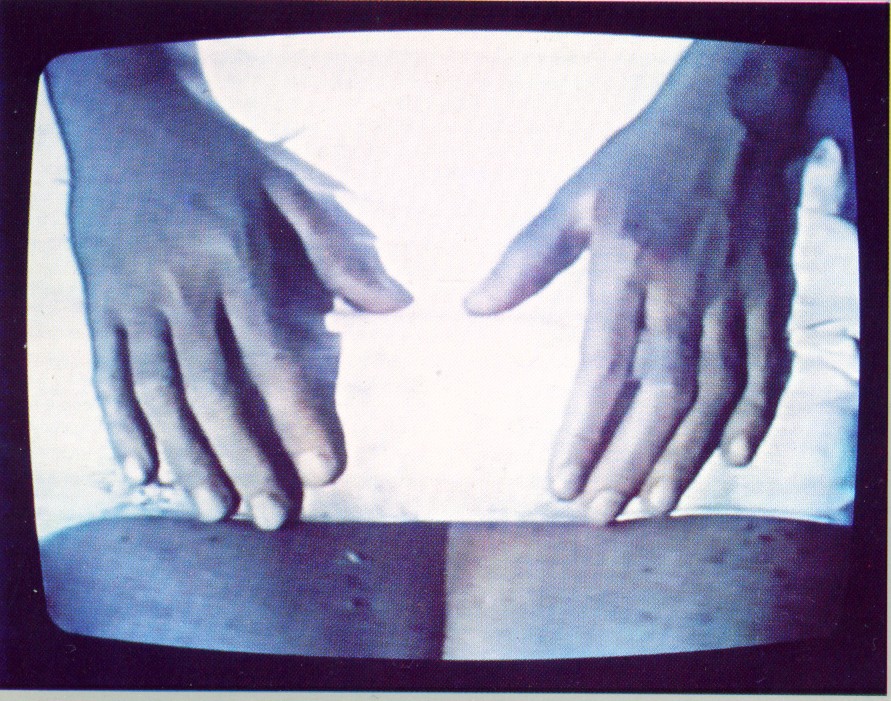
Video Art enables Video statics, a Zero expression of Art or simultanity and creates deep affections filled with astonishment, thus witnesses “a new economy of seeing”. It also enables a Video dynamics through electronic processing figuration and montage. You can find out more about this powerful Art extended media in a short presentation on VIDEO_ART.
Find out something new about Photography as an Art extended media .
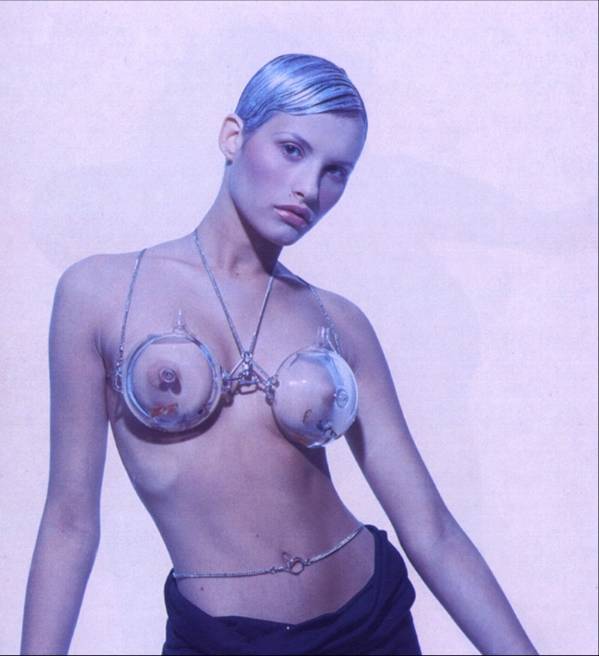
In a short presentation you can explore a brief history of photography, Agency “Magnum”, Fashion photography, “High-fashion model look”, Erotic photography, Photography as a part of installation. Photography (photographs taken from the catalogue, and some of them by artist’s courtesy)
An Ego in ordinary life and the Ego in Contemporary Art as well destroy explicitly the Art of Witnessing and Waiting through a Process! As self-proclaimed creator Ego or Narcissus jumps in his mind and creates more problems…
How to heal the Postmodern Art? “Simply watching the thoughts, the noise inside there, and just waiting for it to be clear.” So, what is the most natural, divine and spiritual Creation you can imagine? Art of Imagination, Meditation and Sexual healing!
“Sexuality means “sex appeal”, erotic phenomenon, not as hedonism. Erotic attraction, as magnetism, the states of potent exsistence and especially autoerotics compose a strongly exalted mental image, as a bases for photogenics.
Such mental image creates a “counterpart” or phantom who is connected closely to photogenics. In video art and experimental films sexuality is expressed as extremely freed and natural energetic source, without simulations.”
At the Zagreb film festival (17th-23rd October, 2010) You can see the Juanita Wilson`s film “As if I am not there” (Tuškanac cinema, Saturday, October 23rd at 21.00 ) made in coproduction of Ireland, Macedonia and Sweden, based on Croatian journalist and writer Slavenka Drakulic´’s book of the same name.
Synopsis As If I Am Not There is a story of a young woman from Sarajevo whose life is shattered the day a young soldier walks into her apartment and tells her to pack her things. Rounded up with the other women from the village and imprisoned in a warehouse in a remote region of Bosnia, she quickly learns the rules of camp life.The day she is picked out to ‘entertain’ the soldiers, the real nightmare begins. Stripped of everything she ever had and facing the constant threat of death, she struggles against all the hatred she sees around her. In a final act of courage or madness, she decides to make one last stand: to dare to be herself. And this simple act saves her life. It’s when she realises that surviving means more than staying alive that she has to make a decision that will change her life forever. As If I Am Not There is a modern war story that explores love, identity and the connections based on Croatian journalist and writer Slavenka Drakulic´’s book of the same name.
Awards Sarajevo Film Festival, Toronto International Film Festival
The 25 FPS will take place from 21st to 26th September 2010 in Zagreb, Croatia.
The 6th Festival 25 FPS is organized by Association for Audio-visual Research 25 FPS. The festival is supported by the Office of Culture City of Zagreb, Croatian Audiovisual Centre , Ministry of Culture Republic of Croatia and Student Centre University of Zagreb. Festival takes place at Student’s Centre in Zagreb, Savska 25.
25 fps denotes the number of full video frames per second as used in the European PAL video system, in contrast to film’s 24 or NTSC video system’s 30 frames per second.
On November 30th and December 1st, many of the most innovative people and organizations in the science and technology world came together in New York city for an historic gathering – the 2010 World Technology Summit & Awards — to celebrate each other’s accomplishments, to explore what is imminent, possible, and important in and around emerging technologies, and to create the kinds of serendipitous relationships that shape the future.
The Award winners and finalists are those individuals (in 20 categories) and companies/organizations (in 10 categories) who are — in the opinion of the WTN Fellows and Founding Members, through the Awards voting process — doing the innovative work of “the greatest likely long-term significance” in their fields. They are those creating the 21st century. In category ARTS the FINALISTS were: Carsten Nicolai, Jesse Gilbert, Mark Amerika and Ryoji Ikeda, and the WINNER was Tod Machover (http://www.todmachover.com/)
Called “America’s Most Wired Composer” by The Los Angeles Times, Machover is widely recognized as one of the most significant and innovative composers of his generation, and is also celebrated for inventing new technologies for music, including Hyperinstruments which he launched at the MIT Media Lab in 1986. Machover’s music has been acclaimed for breaking traditional artistic and cultural boundaries, offering a unique and innovative synthesis of acoustic and electronic sound, of symphony orchestras and interactive computers, and of operatic arias and rock songs.
THE ONE TAKE FILM FESTIVAL (18/11-20/11) IS AN INTERNATIONAL FESTIVAL OF FILMS SHOT IN ONE TAKE, THAT IS FILMS SHOT WITHOUT INTERRUPTION, FROM THE MOMENT OF TURNING THE CAMERA ON TO THE MOMENT OF TURNING THE CAMERA OFF. THE ONE TAKE FILM FESTIVAL ELIMINATES A SEEMINGLY INDISPENSABLE PART OF A FILM – NAMELY, EDITING – AND THUS PROHIBITS CUT, DISSOLVE, FADE IN/OUT AND ALL OTHER TYPES OF TRANSITIONS.THE ONE TAKE FILM FESTIVAL IS THE ONLY ONE OF ITS KIND IN THE WORLD, AND IT TAKES PLACE IN ZAGREB.
THE ONE TAKE FILM FESTIVAL INCLUDES FILMS OF ALMOST EVERY GENRE IN IT’S PROGRAMME (DOCUMENTARY, FICTION, EXPERIMENTAL, MUSIC VIDEO AND COMMERCIAL). THE ONE TAKE FILM FESTIVAL, IN IT’S THREE-DAY PROGRAMME, CONVINCED YOU IN THE POSSIBILITY OF EXCLUDING THE CLASSIC CONCEPT OF FILM EDITING IN FAVOUR OF CAPTURING A PART OF REALITY IN ITS CONTINUITY, WHERE THE DIVERSITY OF CINEMATIC LUDISM IS NEVERENDING, AND THE RESTRICTION INCREDIBLY ENTICING.
International festival of mental health, exhibition, performances, theatre plays, cinema, conference.
It is the first international project of this kind in this region. Find the answers to how we became mad, how autism and theatre are connected, do we perhaps need mental pacemakers or how does one fall in love with the Eiffel Tower, by coming to the festival, October 20-24, 2010 at Pogon Jedinstvo and Mochvara Club in Zagreb.
October 23, Saturday (11-16h conference)
● Panel 1: How We Became Mad
11:15h Dušan Bijelić (RS/US), Freud’s Self-Orientalism and the “Nazi Symptom” of Psychoanalysis
12h Ana Peraica (HR), The Victims’ Symptom
12:20h Zoran Roško (HR), How Did We All Become Mad?
● Panel 2: Doctoring the Mind
13:45h Sergio Benvenuto (IT), Age of Happiness, Age of Depression
14:30h Adi Hasanbašić (BA), The Voice of Madness Live on Air
14:50h Leonard Roy Frank (US), Electroshock Damages the Brain and Destroys Memory / video conference
The Croatian Museum of Contemporary Art (Muzej suvremene umjetnosti-MSU) was founded in 1954 with the aim of following, documenting and promoting events, styles and phenomena in contemporary art. After the old museum, which was located in the Upper Town, new museum was opened in 2009 between capital`s historical centre and its new districts across the Sava river.
This slideshow requires JavaScript.
The collections of the museum include some twelve thousand contemporary artworks, created by Croatian and international artists between 1950 and the present day. the museum includes the following collections: Drawings, Prints, Posters, and works on Paper; Film and Video; Photography; Media art; Sculpture and Painting.
The core of newly founded collection of Media Art is constituted by early computer artworks that the MSU collected during the five international exhibitions entitled New Tendencies, which took place in the period from 1961-1973. The third exhibition of New Tendencies (1965) investigated the relationship between cybernetics and art, while the fourth (1968/69) was dedicated to information theory. In accordance with that, an international symposium on Computers and Visual Research took place in the same year, accompanied by the publication of the first issue of BIT international.
Film Mutations: the Festival of Invisible Cinema is a Croatian filmological project on the modes of film presentation and interpretation, or the politics of film curatorship, Gorgona, 1.- 5.12.2010.
This year’s festival-symposium will take place from 1 to 5 December, 2010, at the MUSEUM OF CONTEMPORARY ART, with programs and lectures by world film scholars, Alexander Horwath (director, Austrian Film Museum), Olaf Möller (permanent curator, Film Festival in Oberhausen), Nicole Brenez (professor, University Paris III) and Go Hirasawa (lecturer, Tokyo University Meiji-Gakuin) and filmmakers Lech Kowalski and Klaus Wyborny, who will start a debate and reflexion on the modes of non-commercial exhibition and on the ethics, aesthetics and politics of poor, minority curatorship.
In previous years, amid discussions of the digital, of the death and mutations of analog film, of the expectations for the archival and museum destiny of film on celluloid tape, a challenge with which film museums and archives will confront the digital age, of the utopian role of museums in relation to the image market, there was a call for a redefinition of the notion of film curatorship.

 The Multimedia artist Vladimir Frelih informed us, as well as Culture.net that he as a “winner of the Kulturvermittlung Steiermark Scholarship, presents his works at the solo exhibition Grosse Schritte kleine bewegung from 4th November to 20th December in Graz.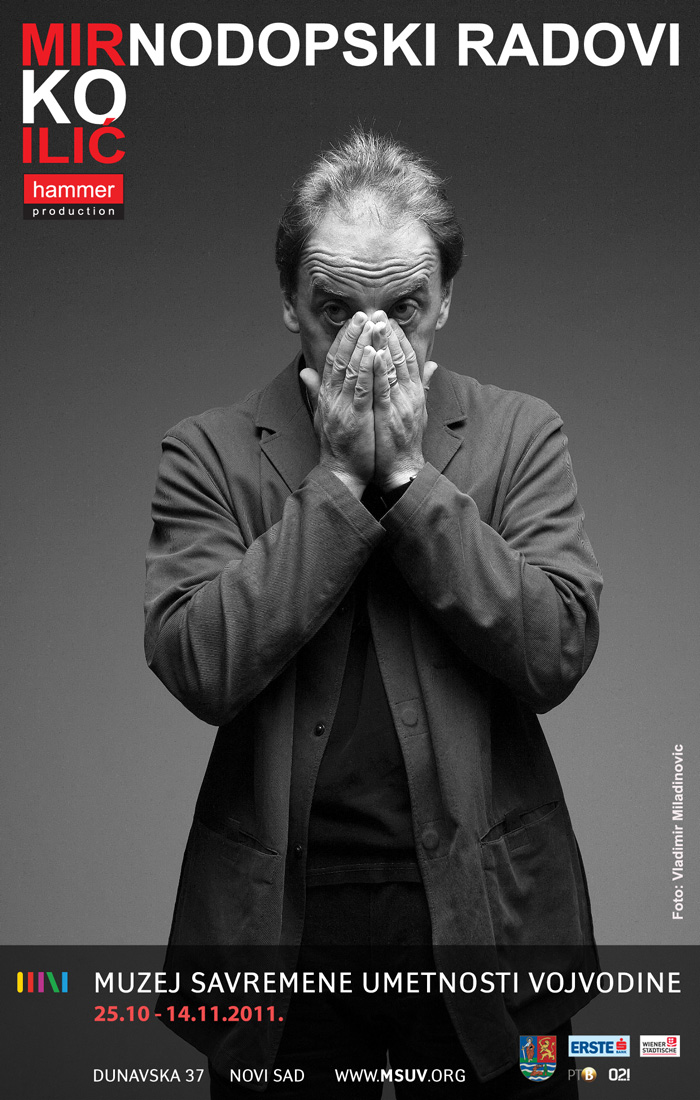





















 Media-Via