Category: Croatia


Branko Franceschi as a curator goes permanently with introducing Croatian Avantgarde art from Marinko Sudac collection of South East Europe avant-garde art production, this time at Kuad Gallery in Istanbul from 24 February to 28 April.

Franceschi states that “so-called state modernism focused on the formal aspects of creativity and creation of art objects and was intensively supported by public institutions, while art practices that aimed to enhance social change towards participatory democracy, or at least to improve the cultural context, were pushed to the margins of public interest and institutional representation. In this manner the creativity of the true heirs of completely neglected pre-WWII radical art practices came to be referred to as the “art of the second line”. (…) Finally, the general understanding prevailed that the avant-garde legacy of modern era, alive and vibrant as it is, most pragmatically and directly connects us with the West we have been aiming to unite with all along. Second-line art became first-line art and a series of major exhibitions has made this heritage visible to local and international communities, creating a possibility of the substantial modification in the mapping of global culture towards a more accurate and impartial model.”

The curatorial concept has been to divide the exhibition into four comprehensive sections. In Print focuses on the legacy and continuation of avant-garde magazine publishing, while Legacy of Constructivism points out how the aesthetic of constructivism permeated and has been transformed throughout the XX century. Subject = Object presents an impressive history of performative art practices in the region dating back to the 1920s and Utopia and Radicalism epitomizes activism that bravely stood against the power and rule of the political elite.”

The exhibition presents 59 works (photography, prints, collages and videos) of Aleksandar Srnec, Attila Csernik, Balint Szombathy, Bogdanka Poznanovic, Boris Demur, Era Milivojevic, EXAT 51, Family from Sempas, Gorgona, Ivan Kozaric, Ivana Tomljenovic Meller, Josip Seissel (Jo Klek), Marijan Molnar, Marko Pogacnik, Mladen Stilinovic, Nasko Kriznar, OHO, Red Peristyle, Tomislav Gotovac, Traveleri, Vladimir Bonacic, Vlado Martek, Zeljko Jerman and Zeljko Kipke.

MV

Source:

the press release
Romulic Multimedia Studio (Mario Romulic and Drazen Stojcic) presents the fascinating movie with hundreds of thousands photographs, created by timelapse technique. “The movie you’re about to see is a preview of what we would like to do, in regards of representing Croatia as a destination in a different way.

No one commissioned us to do this, we put our own work, time, gear, money and ideas into it. Because of this we chose the locations, the editing and music as we saw fit.  Of course, what we ended up putting in this video is merely a fragment of what Croatia has to offer. As photographers who have traveled across our country from one end to another, we are well aware that there is so much more to be filmed. And we are more than happy to do it – after all, we’re two guys who really love their job. It’s simply that the pace at which we can finish this project will depend mostly on if we can get financial support, or we’ll have to figure out some other way to pull this off.

Explaining timelapse technique to an average person, or a potential client can be very hard. Even most of our colleagues have no real sense of how demanding timelapses can be. So we decided to skip on the whining and tried to show what timelapse is really about and how visually attractive it can be.

Almost a full year of work went into this. Months and months of work and hundreds of thousands photographs for a few minutes of video. Sounds silly, but that’s basically how it is. For example, we spent last 3 months literally sitting at our workstations editing and rendering frame after frame, shot after shot, location after location. Crazy people 🙂

So, if by the end of this year we end up with another 4 minutes of worthwhile material, we’ll be more than happy to share!

Until then, lay back, relax and enjoy!”

MV

Source:

Timelaps at vimeo.com

http://www.romulic.com/

Museum of Contemporary Art (MSU) Zagreb presents the exhibition “Silences where things abandon themselves” untill April 3rd, 2012.The exhibition offers a unique perspective over Italian contemporary art and performative scene and displays the works of eleven Italian artists who seem to have deliberately turned away from all decontextualising and “strong” reconceptualising of the “thing” within the artistic dimension.

These artists, on the contrary, seem to have chosen a quite different strategy: they work with given “things” without entirely or partly keeping them away from their respective temporal order. The title of the exhibition is inspired by Lemon Trees (1925), by the Italian Nobel Winner prize poet Eugenio Montale. In Montale’s verse, one may uncover an ideal response to Ludwig Wittgenstein’s conclusive admonition contained in the Tractatus Logico-Philosophicus, “Whereof one cannot speak, thereof one must be silent”: the act of “being silent” is not here to be interpreted as “avoiding to speak”, but rather as an active choice of “being silent about something”. Thus the verse, in a way, determined the choice of the artists for the exhibition.
These artists, with their work, create a peculiar dimension of “silence” in which “things abandon themselves” and betray “their final secret” (Montale), a silence that protects the things from common thinking and, in a way, from art itself.

Artists are: Giorgio Andreotta Calò, Elisabetta Benassi, Rossella Biscotti, Pierpaolo Campanini, Rä di Martino, Christian Frosi/Diego Perrone, Marzia Migliora, Lorenzo Scotto di Luzio, Elisa Sighicelli, Sissi.

MV

Source:

Culturenet.hr

Museum of Contemporary Art

The agile curator and president of the Institute for the Research of the Avant-Garde from Zagreb Branko Franceschi  opens the exhibition “Circles of Interference”  on 27th January in Budapest Kassak Muzeum together with Silvija Malnar, Counsellor, Embassy of the Republic of Croatia in Budapest and Csilla E. Csorba, General Director of the Petb’fi Literary Museum. The exhibition will be opened until 15 April, 2012.

The exhibition Circles of Interference, a collaborative effort between Marinko Sudac Collection, Kassák Museum and Institute for the Research of the Avant-garde, is based on the exchange and cooperative work between the editors of the avant-garde periodicals MA and Zenit, two that were among the most influential in the region at the beginning of the 1920’s. The exhibition covers the issues of networking and expansion of the avant-garde movement and the esthetic of Constructivism that, in between the two wars, had a strong and productive impact on the cultural life of the region.

Artists represented (in alphabetical order): Dragan Aleksić, Csuka Zoltán, Ivan Gol, Kassák Lajos, Ivana Tomljenović Meller, Ljubomir Micić, Marijan Mikac, Farkas Molnár, Branko Ve Poljanski, Bortnyik Sándor, Boško Tokin, Traveleri (Josip Seissel /Jo Klek, Miho Schön, Čedomil Plavšić)…

Magazines and editions: MA, Zenit, Út, Munka, Dada-Jok, Dada Tank, 100%, Dokumentum, Svetokret, Kinofon.

MV

Source:

From the catalogue and by the courtesy of curator.

The internationally famous Croatian video artist Dalibor Martinis introduces to Croatian audience his performance “Simultaneous Speech” in Museum of Contemporary Art ( Zagreb, Gorgona theatre) on January 13, at 19 o’clock. With Dalibor Martinis there are 12 translators: Wang Qiaolan, Lea Kovacs,  Iva Stojevic, Wissam Sleman, Jana Busic,  Kozuko Kono Hut, Ana Petrovic, Marijeta Karlovic, Irena Sertic, Ignacio Esponera, Danijela Vukorepa, Zeljka Salopek, and Marija Popovic.

Dalibor Martinis enters the stage and starts his speech…12 translators simultaneously translate him to 12 languages. But what if they don’t translate his words but those of Fidel Castro in Hungarian, of Mao Zedong in French, of Osama bin Laden in Spanish, of Martin Luther King in Russian, of Gandhi in German, of Lenin in Turkish, of Joseph Beuys in Hindi, of Guy Debord in Greek, of Kasimir Malevich in Japanese, of Marcel Duchamp in Chinese, of Andy Warhol in Arabic, and of Marinetti in Swahili? Actually, it is the artist who translates the “translators” since his speech is composed of all the above speeches, a mixture of key texts of twentieth century, a speech of all speeches. A speech opera. And a lesson in matter of language and ideology. About our all understandings and all our misunderstandings. Does Dalibor Martinis with this stage performance give an ironical comment to the Babylonian language confusion in times of the EU enlargement? Is he comparing us to our mythical ancestors, who failed so magnificently with the building of the Babel tower? Is it possible to generate out of these texts of greatest artists and political leaders some general synthesis of the forever finished twentieth century, or the data recovery may be achieved only through unrelated fragments.

After the performance the book “Simultaneous Speech” will be presented by Nada Beros MSU, Boris Greiner and Dalibor Martinis.

MV

Source:

http://www.culturenet.hr/default.aspx?id=42380

The story of taiko drums has roots in the ancient history of Japan. At the first sounding of these drums, people would stop working and follow the drummers, celebrating the joy of life. World-famous Japanese Yamato drummers played in Zagreb in 2010 and will be back on 26 February, 2012 to play in Concert hall Drazen Petrovic.

Since its creation in 1993, the group has done over one thousand live performances to over one million people in more than 20 countries in Asia, Europe, and the Americas. The group has grown from four to seventeen now and apart from the usual concerts works on many activities involving schools and teaching. They use more than 50 drums on the scene and their characteristics are synchronicity, concentracion, coordination and huge energy.

MV

Source:

culturenet.hr

yamato.jp

muzika.hr

The Croatian doctor of philosophy Sead Alic published his dissertation „Marshal McLuhan’s Philosophy of Media“ at the Center for Philosophy of Media and Medial research in Zagreb. As the author states he tries to find the arguments for the foundations of a new scientific discipline – Philosophy of Media, i.e. for the proofs that it was Canadian Philosopher Marshal McLuhan himself who was the most important theorist opening a new area and developing the method of interdisciplinary approach to the investigation of the media field.  (Alic S., „Marshal McLuhan’s Philosophy of Media“, 2010, page 422)

“The crucial part of the problem is the omnipresence of mass media which are changing human experience, and question not only contemporary philosophical idea (in its relation towards seduction and manipulation of new technologies/media), but also throw light onto the history of development of medial mediation and awareness about the meaning and influence of that mediation“, and later on he stresses that „the work of McLuhan is very often simplified and reduced to syntagms like Medium is Message, Global Village, Culture is our Business and similar.“  (Alic S., „Marshal McLuhan’s Philosophy of Media“, 2010, page 422).
PhD Alic understands together with McLuhan that constant introduction of new media during history has changed the human experience, so it’s necessary to change the approach to Life in general as well. Investigating the problem through the Tradition of Philosophy (Socrates, Descartes, Kant, Hegel, Nietzsche and Marx), Alic uses McLuhan to analyse the concept of Extensions (press technology – books and newspapers, advertising, photography, comics, film, radio, TV, fashion, slang and changes in discourse, and writing) as the central idea of his dissertation. Alic was inspired by McLuhan’s knowledge of Art history and his special attention is focused to the problem of perspective in presentation of Reality. Alic agrees with McLuhan that in tribal times the medium of sound was dominant, while with the invention of the press visual aspects predominated altogether with electronic media, which has resulted  in cultural ruining of human memory .
Doctor Alic had also discussed related ideas of Debord, Bilwet Archive, Debray and Baudrillard, and analysed the critical confrontation of McLuhan’s ideas and Philosophy of Praxis, that he considers an inspiration for opening the Philosophy of Media and inaugurating Marshal McLuhan as the founder of the Philosophy of Media in Postmodernism.
Although doctor Alic, while inspired by Marshal McLuhan’s accordance with the avant-garde, emphasizes a lot of good and bad sides of mass media impact on human health and culture in general, (what sounds realistic as Alic’s inner dialogue is preserved or won), still there is a question concerning his deep fear of media manipulations as he can’t escape them. How to prevent ourselves from media manipulations? Not everything is in sounds and words which he prefers as a doctor of Croatian Literature as well, by devaluating visual communications he just „guesses“ in the end of the dissertation that there are many meanings  in the (archetypical) pictures that carry the potential of consciousness. Our thesis is that affective deepening in unconscious or artistic roots of Media Art, truly guard or economize us humanly to transform transpersonally from the digital stucking into the anthropological safety of humanized technology.

Changing consistency from very concentrated to casual mood, Alic is popular enough to be interesting, but unnecessarily eccentric and not persuasive as he could be. It is strange that in his very valuable book there are so many typographical mistakes,  indicating that the book was published in a hurry.

As a co-founder and a member of Program comittee PhD. Sead Alic, together with PhD. Divna Vuksanovic (Serbia) organized International Interdisciplinary Symposium PHILOSOPHY OF MEDIA – Issues of founding, establishing and/or revelation in September, 2011, on the island Cres, thus celebrating the centenary of the birth of Marshall McLuhan.

PhD Vesna Srnic, media-via editor

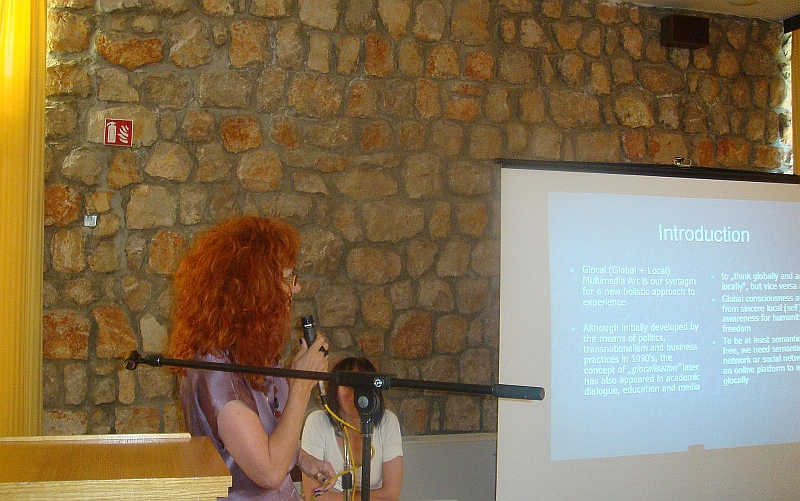
Glocal Multimedia Art is our syntagm for a new holistic approach to experience. Although initially developed by the means of politics, transnationalism and business practices in 1990’s, the concept of „glocalisation“ later has also appeared in academic dialogue, education and media.  

Thinking either globally or locally (glocally) at the same time, means not only to „think globally and act locally“, but vice versa as well. Global consciousness arose from sincere local (self) awareness for humanity and freedom.  We have to be free for awareness as well. So, we need information, education and proactivity to create our own events and chances. To be at least semantically free, we need semantic network or social network for an online platform to act glocally.

Furthermore, in order to make an Art of something Glocally imagined, several skills are needed. First of all you need knowledge of IT and creative imagination on how to practice performing Arts, especially in multimedia synergy. You also need communication skills of a person basically humanistic or cosmopolite oriented, yet locally and globally are not mutually exclusive, rather they imply that you have self-awareness and self-confidence to be centered on „the big picture“.

To paraphrase a famous humanist PhD Ivan Supek, globalisation as a „global machine“ is preparing its own failure with greed and destruction of nature, thus encourages solitaries and dreamers on messiah campaign, but maybe it is only the United Europe which can confront the uncontrollable global capitalism.  (Introduction from PhD Vesna Srnic’s “Glocal Multimedia Art” presented at The Philosophy of Media Symposium at Cres, 2011.)

Whole work: Glocal Multimedia Art/PhD Srnic.pdf

PhD. Vesna Srnic

The exhibition will be opened in Slovenian Gallery “Skuc” (Ljubljana, 21st December, 2011 – 12the January, 2012) as the reflection and expansion on the previous part the curator Branko Franceschi has  successfully introduced last month in New York.

High Times: Reflections of Pscyhedelia in Socialist Yugoslavia 1966 – 1976 makes manifest the ever intriguing and fruitful rapport between vanguard artists and popular culture, occurring within the unique context of a society that managed to create its own political, economic, and social system based on its vacillation between East and West during the height of the Cold War.

In the broader cultural sense, the entire collection of High Times: Reflections of Pscyhedelia in Socialist Yugoslavia 1966 – 1976 aims to change the accustomed understanding of Yugoslavia’s neo-avant-garde and new media practices as being inexpressive or too serious in their social engagement and agenda, as well as colorless and materially reduced in their formal aesthetics. (Excerpt from an essay by curator Branko Franceschi.)

Presented works (some from Marinko Sudac collection), performances and music of the authors: Marina Abramović, Marjan Ciglič, Grupa 220, Indeksi, Korni grupa, Mišo Kovač, Zdenka Kovačićek & Nirvana, Naško Križnar, Josipa Lisac, Ivan Martinac, Slavko Matković, Miroslav Mikuljan, Vladimir Petek, Marko Pogačnik, Ante Verzotti, Slobodan Šijan, Ljubomir Šimunić, Time, Petar Trinajstić, Uragani

MV

Source:

galerija.skuc

Croatian artist Sanja Ivekovic as a feminist, activist, and video pioneer will be introduced in MOMA in New York from December 18, 2011–March 26, 2012. The museum covers 40 years of  her work, from the early 1970s when artists broke free from mainstream institutional settings, laying the ground for a form of praxis antipodal to official art, till a contemporary recent works. Part of the generation known as the Nova Umjetnička Praksa (New Art Practice), Iveković produced works of cross-cultural resonance that range from conceptual photomontages to video and performance.

As the culturenet.hr informs “this exhibition brings together a historic group of single-channel videos and media installations, including Sweet Violence (1974), Personal Cuts (1982), Practice Makes a Master (1982/2009), General Alert (Soap Opera) (1995), and Rohrbach Living Memorial (2005). Among the 100 photomontages featured in the exhibition is Iveković’s celebrated series Double Life (1975–76), for which the artist juxtaposed pictures of herself culled from her private albums with commercial ads clipped from the pages of women’s magazines.”

“(…) After 1990—following the fall of the Berlin Wall, the disintegration of Yugoslavia, and the birth of a new nation—she focused on the transformation of reality from socialist to post-socialist political systems. Iveković offers a fascinating view into the official politics of power, gender roles, and the paradoxes inherent in society’s collective memory.”

MV

Source:

culturenet.hr

moma.org/

During 70’s Croatian artist Zarko Vijatovic, now living and working in Paris, has created in a sync with a conceptual multimedia artist and director Tomislav Gotovac, a complex serial of photographies. The exhibition can be seen on 18 November 2011 – 17 January 2012 in Warshaw Art museum and You can enjoy in works of these photographers and artists in collaboration: Hollis Frampton – Carl Andre, Peter Hujar – Paul Thek, Eustachy Kossakowski – Edward Krasiński, János Vető – Tibor Hajas, Žarko Vijatović – Tomislav Gotovac, Gwenn Thomas – Joan Jonas, Gwenn Thomas – Jack Smith, Babette Mangolte – Yvonne Rainer, Shunk-Kender – Pier 18.

“The nine stories told by this exhibition each concern the meeting of a photographer and an artist. Their collaboration was sometimes one-off, sometimes it would last for years, but it always resulted in common fruit: a work of art, a process, a shared world. We are interested in the working experience of these “accomplices”, and how their collaboration shaped the work that was being created. Their role wasn’t limited to just recording, they weren’t only an extension of the documenting camera – very often the process of exchange between the photographer and the artist was highly complex and determined the project’s ultimate shape.”

Source:

kulturpunkt

artmuseum

Archive of  Tomislav Gotovac / Photo: from serial Krajiška 29, 2008

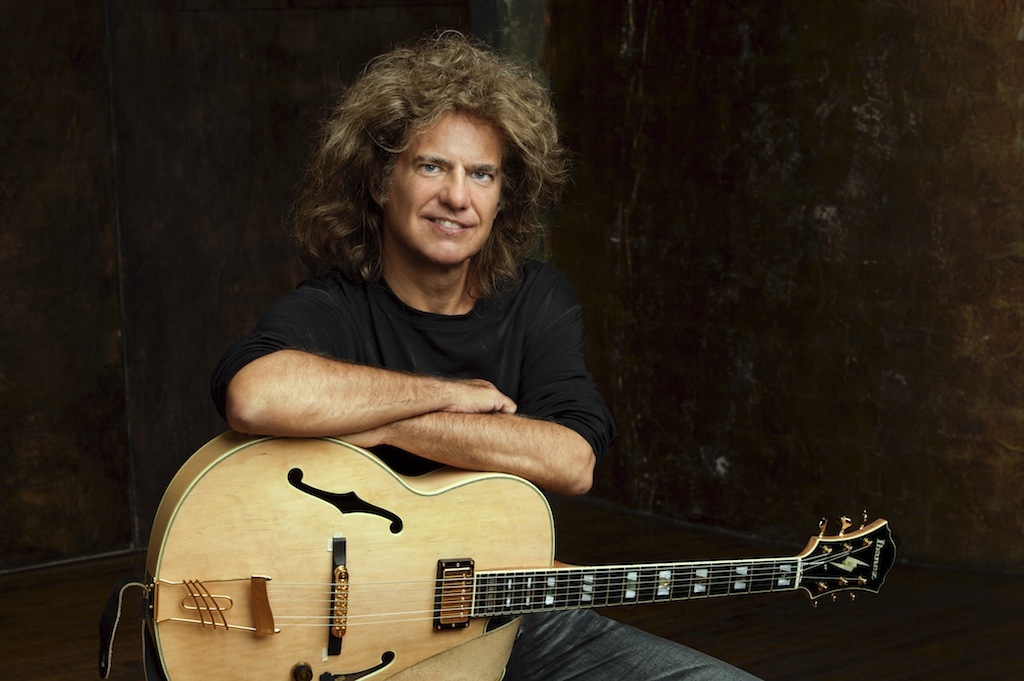
The 7th Vip Zagreb Jazz Festival presented Pat Metheny Trio (Larry Grenadier – bass and Bill Stewart – drums) on 11th November in front of a huge, excited audience of Student center, with the crowd sitting on the floor! There he is: warming up!

As we stressed in the previous post Pat Metheny, throughout his career, has continued to re-define the genre by utilizing new technology and constantly working to evolve the improvisational and sonic potential of his instrument.

Source:
http://media-via.net

The Multimedia artist Vladimir Frelih informed us, as well as Culture.net that he as a “winner of the Kulturvermittlung Steiermark Scholarship, presents his works at the solo exhibition Grosse Schritte kleine bewegung from 4th November to 20th December in Graz.

Born in Osijek in 1963, studied Sculpture/Installations at Kunstakademie Düsseldorf (Germany). His tutors were Professors Hoover, Paik and Jatel. He became a Master Grade student in 2001 and attended tutorial classes by Professsor Jatel. 2008 Multimedia Lecturer at the Osijek Academy of Fine Arts and leader at the Department of Art. From 1994 his work has been shown nationally and internationally at exhibitions and events.

He uses a variety of art media and techniques with reference to their structural faults and advantages. His art work has received a number of awards and scholarships and is on display in several contemporary art collections and museums. Currently based in Osijek and Düsseldorf.”

MV

Source:

Culture.net

Cultural City Network Graz

Renowned pianist McCoy Tyner will open the 7th annual VIP Zagreb Jazz Festival on 10 November. The festival will take place in freshly renovated Student Centre hall that can seat 1,000 people. The highlights of this year’s festival are Pat Metheny Trio, Lucky Peterson and sax player Pharoah Sanders.

McCoy Tyner Trio featuring Jose James & Chris Potter

A Contemporary Exploration of John Coltrane & Johnny Hartman

McCoy Tyner – piano, Gerald Cannon – bass, Joe Farnsworth – drums, Jose James – vocals, Chris Potter – saxophone

Pat Metheny Trio/ 11th November

w/Larry Grenadier & Bill Stewart

Pat Metheny – guitar, Larry Grenadier – bass, Bill Stewart – drums

Lucky Peterson

Lucky Peterson – Vocals, Guitar, Rhodes, B3 Organ, Raul Valdes – Drums, Timothy Waites – Bass

Pharoah Sanders Quartet

Pharoah Sanders – Tenor Saxophone, Gregory Bandy – Drums, John Webber – Bass, William Henderson – Piano

This year the special star – Pat Metheny, throughout his career, has continued to re-define the genre by utilizing new technology and constantly working to evolve the improvisational and sonic potential of his instrument.

MV

Source:

culturenet

vip zagreb jazzfestival

http://www.patmetheny.com

The prestigious American media “The Village Voice” presents Croatian curatoring of Branko Franceschi’s exhibition “Tune in Screening: Psychodelic Moving Images from Socialist Yugoslavia 1966-1976” as the best or Top Arts story in New York at the moment.

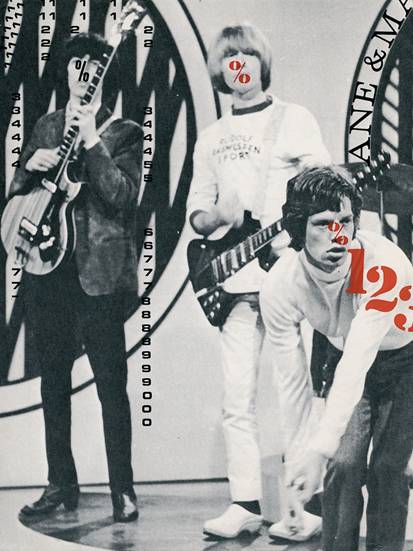
A journalist R.C. Baker explains: “Post-World War II Yugoslavia threaded a Cold War needle between the Soviet Union’s Communist hardliners and the West’s hedonistic capitalists. This national schizophrenia perhaps explains the fantastic flowering of proto-MTV films and conceptual objects created by the Slovenian avant-gardists known as the OHO Group. In 1968, an OHO founder, Marko Pogacnik, crafted a puzzle by slicing up a photo of the Rolling Stones and gluing the pieces to a dozen matchboxes. In a recent interview, the artist summed up his affecting object (which opens the exhibition): “In the same way that matches appear when one needs to build the fire, pop culture ignited our imagination.”(…)”

Although the journalist Baker writes about the cultural moment of the analysed period in the exhibition, we think that he missed so much regarding philosophy and curatorial capacity.

MV

Source:

http://www.villagevoice.com

The Perforations Festival program spans over three cities (Rijeka, Zagreb, Dubrovnik) from October 20 – 29, 2011. The festival includes more than 15 other productions from Slovenia, Serbia, Macedonia and Romania. Some of the artists are Rosana Hribar / Gregor Luštek, Mala Kline, Angelo Madureira / Ana Catarina Vieira, Manuel Pelmus, Ljiljana Tasić / Dušan Bročić, Damir Bartol Indoš, Via Negativa, etc.

The Perforations Festival takes place annually in three Croatian cities; Zagreb, Rijeka and Dubrovnik and presents a range of artists working in performance art, theater, and dance, whose diverse approaches to art-making blurs the borders between these genres. While their work touches upon issues of identity (public, political, religious, ecological),  of borders redefinition and space, of a collective past, and of personal histories, most of all their work talks about the present. Highlights from this festival were presented at the LaMama E.T.C., New York, offering audiences insight into contemporary lines of artistic thinking from some of the most provocative and influential artists in the region.

This week they have published interviews with Marko Mandić, Tea Tupajić and Alen Sinkauz.

MV

Source:

http://www.perforacije.org

The exhibition of the Croatian artist Boris Bucan called ‘Streetcan be seen until October 30 in the Croatian Glyptotheque in Zagreb . The selection and exhibition are signed by the respected academician Vera Horvat Pintaric.

ulica“Not only the street, but also imagination! (…) A little bit of reality and a lot of imagination. (…) Why not, Bućan imagines that simultaneously can see two skies, I guess it’s on the left side the morning sky marked with the blue, on the right side the evening sky when the great white prevailes blue evening light at the end of the horizon.

One eye sees, the other changes what is seen. We know who owns these two eyes and who can change the world in the image. Only a selected few...”

Boris Bucan (Zagreb, 1947) graduated from the Academy of Fine Arts in Zagreb in 1972. His artistic practice includes drawing, graphics and graphic design. He pays special attention to the issue of the anonymous media message which he personalizes through humorous interventions in the template (Bucan Art, 1971). At the start of his career, he created posters for the Student Center in Zagreb (Galerija i Teatar ITD – Gallery and the ETC. Theatre) and Dramsko kazalište Gavella (Drama Theatre Gavella) (1967-1972). Between 1980 and 1982 he created a famous large-sized poster series recognized for their picturesque quality for HNK (Croatian National Theatre) in Split, and for the concert program of Radio-televizija Zagreb (Radio-Television Zagreb). After the series was exhibited at the 1984 Venice Biennial, Bucan earned international fame.

Also, as a part of the “Artist on Vacation” project he presented his series of works Bucan Art” in seaside villa Polensi, as a prelude to a much larger body of work “Bucan works” that will be presented in autumn, next year at the exhibition of pop art The Pop Goes the Worldat the Tate Modern in London, and then in the Pinacoteca do Estado de Sao Paulo in Brazil.


MV

Source:

culturenet.hr

novilist.hr

The  Croatian Gallery Zitnjak invites You to a special exhibition about Art & Food connection on Saturday, 15th October, from 3 pm. till evening. The artists, as well as guests will prepare some food, while testing the recipes!

Some of the very famous Croatian artists will show their skills on preparing and tasting food:

VLASTA ŽANIĆ, MARIJAN MOLNAR, BORIS CVJETANOVIĆ, VLADIMIR FRELIH, ANTONIJA BALIĆ ŠIMRAK, VESNA POKAS, MARKO MARKOVIĆ, ZORAN PAVELIĆ, JASENKA BULJ, JASENKO RASOL, HAMO ČAVRK, DALIBOR MARTINIS, TANJA DABO, MLADEN STILINOVIĆ, BORIS SEKULIĆ, ŽELJKO BADURINA, IVANA JELAVIĆ, ANA HUŠMAN, MARIJAN CRTALIĆ, HRVOJE ŠERCAR, DENIS KRAŠKOVIĆ, ĐORĐE JANDRIĆ, MEJRA MUJIČIĆ, KATA MIJATOVIĆ, DORA KOVAČEVIĆ, VLADIMIR MEGLIĆ, ALEM KORKUT, HRVOJE MITROV, IRENA SERTIĆ, ANTUN BOŽIČEVIĆ, BOŽO KATIĆ

Although it’s the season of “sour cucumbers” and many artists are still trying to make conceptually fun of serious topics, we stay on a position of reflecting scientifically/artistic synthesis and adore deep affectionate synesthesia.

MV

Source:

Courtesy of Gallery

‘Tune in Screening: Psychedelic Moving Images from Socialist Yugoslavia”,  the exhibiition curated by Branko Franceschi opens on 2nd October (6-9pm) in Stephan Stoyanov Gallery in New York. The exhibition is on view till 30th October.

Between 3rd and 30th October Franceschi will open a Virtual Museum of Avant-garde Art’s Overseas Headquarters located in New York’s organization Residency Unlimited. The project will function as a temporary office for meetings, open talks, and plan making regarding the museum and possible future collaborations.

Branko Franceschi is a director of the “Virtual Museum of Avant-garde Art” http://www.avantgarde-museum.com, based in Zagreb, Croatia. The Virtual Museum of the Avant-garde aims to compensate the shortcomings of virtual reality through the direct exchange of knowledge on Southeastern Europe’s avant-garde movements to professionals, artists, students and the general public of New York. “The screening focuses on experimental film production and rock music created in Yugoslavia from 1964 to 1974. The materials all indicate a degree of openness and permissiveness that characterized Yugoslavia’s brand of socialism when importing and incorporating pop and alternative culture from the West. This cultural exchange influenced local society, arts, and, especially, Yugoslavia’s lifestyle and popular culture.”

Trained as an Art Historian at the University of Zagreb, for more than 20 years Franceschi has initiated and curated numerous exhibitions of contemporary art for exhibition venues in Croatia and beyond. Membership: AICA (AICA Croatia President), ICOM, CIMAM, DPUH, Advisory Committee of Art in General, New Media Commission for the Ministry of Culture Republic of Croatia (President), Gallery and Museum Program Commission for the Municipality of Rijeka (President).

The programme is realized with the support of  CEC Artslink  www.cecartslink.org, as well as Croatian Ministry of Culture, and the activity of “Virtual Museum of  Avant-garde Art” is assissted by The Town Varazdin.

(Tune in Screening_essay)

MV

Source:

culturenet.hr

http://www.residencyunlimited.org

 Anne Bean and the Live Art Development Agency would like to invite you to a  special event, a performance by:

Vlasta Delimar and Milan Bozic

Absolute Artist (Memories and Feelings) Antonio Gotovac Lauer

On: Wednesday 12 October at 7pm.

At: Rochelle School, Arnold Circus, London E2

Antonio G. Lauer a.k.a Tomislav Gotovac (1937-2010) is representing Croatia at the 54th Biennale di Venezia in the exhibition entitled One Needs to Live Self-Confidently… Tomislav Gotovac was an avant-garde film director and performer, whose complex and multi-layered projects, combining a range of different art practices, are considered pioneering and anticipatory in the areas of structuralist and experimental film, conceptual art, body art, and performance.

MV

Source:

Courtesy of the Artist

International Interdisciplinary Symposium PHILOSOPHY OF MEDIA – Issues of founding, establishing and/or revelation,  will be held on the Croatian island Cres between 16-18 September, 2011. Media-via portal editor M.A. Vesna Srnic is invited to present her papers “Glocal Multimedia Art” at the symposium, organised in the year in which we celebrate the centenary of the  birth of Marshall McLuhan.

In front of Program comitee PhD. Divna Vuksanovic (Serbia) and PhD. Sead Alic (Croatia) stressed: “We live in a time of media intercession, networking, virtual worlds, a growing impact of mass media on politics, culture, human life, experience, or even opinions as such. We exist in a time when the immersion into the world of the mass media reminds us of the fact that we as human beings throughout history have been determined by some sort of media and that only the modern preoccupation with the (mass) media has given rise to an awareness of (partial or total) oblivion of media intercession,especially during times of oral communication, written and print form.” (…)   “In this sense, the philosophy of media co-opts the scientific research of linguistics, psycholinguistics, media theory, the theory of special art, knowledge of techniques and technologies, research psychology, medicine, phonetics, cultural and visual studies, and other science disciplines, theoretical knowledge and practice experience.” tENrNp4O_ZE

Symposium sponsors are  Ministry of Science, Education and Sports of the Republic of Croatia, Croatian National Tourist Board, Town of Cres and Hotel Kimen Cres.

This slideshow requires JavaScript.

MV

Source:

Programme of Symposium

The Croatian Gallery Miroslav Kraljevic  opens on the 16th September the Asier Mendizabal exhibition – Landing, indicating the mechanisms of relationship between apstract modernism and ideology.

“Asier Mendizabal (Ordizia, Guipuzkoa, 1973) is one of the Basque artists of the new generation who pays most attention to the relations between form, discourse and ideology. His oeuvre could be described as a critique of ideology based on the mise en scène of the structures that shape it. Through the expanded fields of art, rock music, cinema, politics and theory his view on social structures leads him to sketch out a map of the totality of production relations. Asier Mendizabal’s transversal, multidisciplinary approach focuses sharply on the difficulties of representation inherent in the political, as well as on the gaps between artistic activity and the “political unconscious” present in cultural productions, manifestations of the collective and mass movements.”

MV

Source:

http://www.macba.cat

On September 11, 2001 director Dan Oki was living in New York and witnessed the terrorist attack and its consequences firsthand. In this film, he takes his documentary footage from that fateful day and puts it in the context of a feature film. Projections of a film will be held at Zagreb (on September 11), Berlin and New York (on September 12). 
A theatre troupe from Croatia travels to New York on September 10, 2001. The troupe is a diverse group
made up of a young married couple and their son, two girls, and a young man. They are welcomed by their
producer, a New Yorker of Croatian descent, whose husband works at the World Trade Centre. Suddenly,
without warning, the troupe finds itself in the middle of the destruction of September 11.
The relationships between the characters come under pressure and begin to change as a reaction to the
sheer force of the events unfolding all around them.

THE PERFORMANCE
78 minute, HD-Cam, 2010
Writer and Director: Dan Oki
Director of Photography: Raul Brzic
Composer: Vjeran Šalamon
Editor: Davor Švaic
With: Vanda Boban, Marin Tudor, Lana Hulenic, Marko Petric, Elena Orlic,
Luka Jokic Sterle, Sandra Sterle, Brian Willems.
Production House: Studio Fugo 

Schedule of the projection

ZAGREB  - Sunday, September 11, 2011, 6 PM
Museum of Contemporary Art
Avenija Dubrovnik 17,
10000 Zagreb, Croatia

BERLIN - Monday 12. September at 8.30 p.m.
BABYLON – Cinema 1
Rosa-Luxemburg-Str. 30,
10178  BERLIN, Deutschland
http://www.babylonberlin.de/performance.htm

NEW YORK – Monday, September 12, 2011, 8PM
THE THING @ WHITE SLAB PALACE
77 Delancey St
(between Allen St & Orchard St)
New York, NY 10002
Neighborhood: Lower East Side
http://post.thing.net/node/3477

Dan Oki (Slobodan Jokic, Zadar, 1965) is an internationaly renown media artist for twenty years. 
As a producer, writer and director he made three feature films: Oxygene 4, Performance and the Dark.
He teaches as a Film and Media Arts professor at UMAS in Split and ADU in Zagreb.
MV

Source:
(from the catalogue)


“We are more – act for culture in Europe”  is a Europe-wide campaign for the arts and culture. It was launched in October 2010 and will run until 2013, when the EU decides about its next multiannual budget. This campaign wants to show that we are many organisations built up by individuals who value and act for culture in Europe, as it is Media-via editor’s association ‘Culture, Media and Education’ – ARTHEA which is applying a project “Glocal Multimedia Culture”.

“The we are more campaign promotes culture, heritage and the arts, together with education, social cohesion and environmental sustainability, as key areas in which the EU has to make more bold investments if it wants to reach its growth objectives and Europe to remain a thriving democracy in the future.

The campaign aims to influence the negotiations on the next multiannual EU budget beyond 2013 – an opportunity that only comes once every decade! The EU budget will be negotiated over the next two years and we want to make sure that the EU contribution to culture is explicit and with a stronger financial envelope. Read the campaign statement on the European Commission’s budget proposal here (published in July 2011).

The two campaign demands are: A bold and daring Culture Programme for the period 2014-2020 that will fund cutting edge artistic and cultural experimentation around our common European concerns and aspirations. A programme that will support innovative cultural co-operations, and experiment with new artistic, intercultural, social and economic models.”

MV

Source:

http://www.wearemore.eu/

kulturpunkt.hr

A three in one postgraduate study: acting, media in which the acting occurs, and culture created by acting was founded at the University of Rijeka by the internationaly famous actor Rade Serbedzija. He also founded the Ulysses Theatre in 2000 in Brijuni, where he  directs and acts in most plays.

The postgraduate programme was established on December 14th, 2010 by the Senate of the University of Rijeka as a two-year course for specialising in acting, media and culture field of research. Anyone can enroll into the programme, provided they have a valid university degree and have passed the admissions exam. The programme lasts two years (four semesters) during which theory and practice intertwine through courses such as Voice, Acting, Dramaturgy of Performance, Reading Drama, Characteristics of the Cultural System, Actor as Musician, Philosophy of Arts, Actor and Choreography, Postdrama Theatre.

Main aims are training the students to become critics, theoreticians, scientists that have empirically tested methods and challenges of acting process, as well as interdisciplinarity, interactivity and internationality as the policy of the programme. Part of the courses will be held in English, involving collaborators and professors from foreign leading universities and art schools, such as Nigel Osborne, Reid professor of Music at the Edinburgh University; Staša Zurovac, director and choreographer; Nikola Petković, writer; Snježana Prijić-Samaržija, philosopher; Robin Carr (University of Southern Mississippi) and Deborah Kinghorn (University of New Hampshire), masters of Lessac method for voice and acting; Elvio Baccarini, philosopher; Karpo Godina, film director and DoP, and many others.

MV

Source:

http://www.acting.uniri.hr

On Wednesday, 27 July through August, the filming of  Goltzius and the Pelican Company by British art film director Peter Greenaway began in Zagreb. The creative part of the crew includes around 60 Croatian members with filmmaker Zoran Sudar  as the best Croatian co-production first assistant director with international reputation.

“The story takes place in 1590, at the time when Dutch painter Hendrik Goltzius negotiated in a castle on the Rhine with the rich Alsatian nobleman Margrave to ensure him the funds for a print press. Goltzius wished to print eroticised versions of illustrated Old Testament tales. The nobleman’s castle, enthralled with Goltzius’ seductive tales, drenched in the motifs of incest, adultery, and rape, slowly sinks in the trap of aroused lust, and consequentially in a conflict with religious circles.

The role of Goltzius is played by Dutch actor and poet (the current Dutch Poet Laureate 2009-2012) Ramsey Nasr, and the film also stars American actor F. Murray Abraham (Amadeus, All the President’s Men, Scarface), French actress Kate Moran, Italian actor Pipo Delbono, and Croatian actors and actresses Nada Abrus, Katja Zubčić, Goran Grgić, Enes Vejzović, Duško Valentić, Milan Pleština, Tvrtko Jurić, Vedran Živolić, Samir Vujčić and Goran Bogdan.”  The creative part of the crew includes around 60 Croatian members with filmmaker Zoran Sudar (The Last Will ) as the best Croatian co-production first assistant director with international reputation ( Anton Chekhov’s The Duel, White Lightnin’, The Hunting Party, The Peacemaker.

“Peter Greenaway is the author of one of the most exciting film works of today. Film devotees remember him by the extraordinary classic The Cook the Thief His Wife & Her Lover from 1989. Since then he has acquired the cult status thanks to his films  The Draughtsman’s Contract (1982), The Belly of an Architect (1987), and Drowning by Numbers (1988). His digital analysis of the painting The Wedding at Cana by the mannerist painter Paolo Veronese was screened at the Venice Biennale in 2009.  A New York Times critic called it one of “the best art history classes of all times””.

Sources:

http://www.culturenet.hr

Motovun Film Festival runs from July 25 to July 29 for the 13th consecutive year offering some of the best cinema productions from around the world. This year the festival premiers a film by Wim Wenders dedicated to Pina Bausch.  

Motovun Film Festival is entirely dedicated to films made in small cinematographies and independent productions, films that broke out through their innovation, ideas, and the power of their stories. In everything, except for the ambition and the quality, Motovun wants to be a small festival showing small films, small in the warmest sense od the word.

Motovun Film Festival is a five-day film marathon in which film screenings alternate from 10 a.m. until 4 a.m., with evening outdoor screenings and daily screenings in theatres. Festival program consists of around 70 titles from all over the world, from documentaries to feature films, from shorts to long forms, from guerilla made films to co productions. The only criteria in their selection is that they fit in the open-minded atmosphere of the festival with their innovations. This year the festival is being held for the twelwth time.

motovunfilmfestival

Dr W.J.T. Mitchell from the University of Chicago, was a key-note speaker at the event Visual Studies Today – The Power of Images, which was organized by the Center for Visual Studies, Zagreb from 7th to 8th November 2013, as well as at the conference Visual Studies as Academic Discipline . Dr Mitchell is the most famous authority of visual studies in the world.  (Schedule) Dr Mitchell’s talk was titled “Seeing Madness: Insanity, Media, and Visual Culture” and it raised two questions:”1) Is it possible to “see madness” or to represent it visually with any kind of certainty? 2) What motivates the desire to see madness, to put it on stage, or to capture its variable manifestations in visual images?” Examples were drawn mainly from photography, operatic spectacle, and cinema.

NGO “Culture, Media and Education” president and Media-Via editor Dr Vesna Srnic attended the lecture and because of the lack of time asked Dr Mitchell a question in writing, that he will possibly answer.

This is a question of Dr Srnic:

“In Critical Inquiry, in 1991st, you interviewed famous American conceptual artist Barbara Kruger. When you elaborated the relation between Image and Word, as well as about Gender and Embodiment, you provoked Barbara Kruger with this /quotation:

„You  can go back  to  the Old Testament to find sentiments like  “a silent woman  is  the gift of God.”

and KRUGER said: Oh,  let me write that down.“ /unquote (Critical Inquiry, 1991, p. 445)

 I think this is a very interesting moment in that interview, because of several possible interpretations: on charismatic, feminist, Leftist level Kruger was understandably surprised, although she should have known the point of that religious view, and did not mock; another Rightist level is well known for its meaning as the mystical power of silence.

 What I would like to ask you is if you can see the theses of the third meaning in the phenomenology of Time and Space as Here and Now, in the performative middle way, thus artistically rejecting Gender differentiation, rejecting Images and Words completely, as well as Leftist and Rightist positions and oppositions?

 Is this „spinning wildly or standing still“ significant Spiritual Embodiment for you and can be seen as, although marginal, the rejection of the Madness?”

MV


MARK TRIBE: ‘THE DYSTOPIA FILES’ (Zagreb, June 9th – July 9th 2011),  ‘Performance, mediation and public sphere’, workshop and public lecture

„The Dystopia Files“ (A dystopia – from Ancient Greek: δυσ-, “bad, ill”, and Ancient Greek: τόπος, “place, landscape” is the idea of a society in a repressive and controlled state), at g-mk is the newest iteration of Mark Tribe’s ongoing project, which recontextualizes the history of demonstrations in the US. The artist had gathered an archive of protest footage, which serves as a base for creating site specific video installations in gallery and museum spaces. The work tackles on a set of questions about power relations, spectatorship, image manipulation, participation, interaction and political engagement. The relationship between these issues and recent curatorial practices will be discussed during the workshop held by Mark Tribe. In a talk following the workshop, Mark will present his multimedia artistic practices, including his previous acknowledged projects such as Rhizome and Port Huron ( The Port Huron Project is a series of reenactments of protest speeches from the New Left movements of the Vietnam era). The exhibition is curated by Željka Himbele Kožul.

MV

http://www.g-mk.hr

http://rhizome.org

http://www.marktribe.net