Tag Archive: Philosophy


Dr. Vesna Srnic

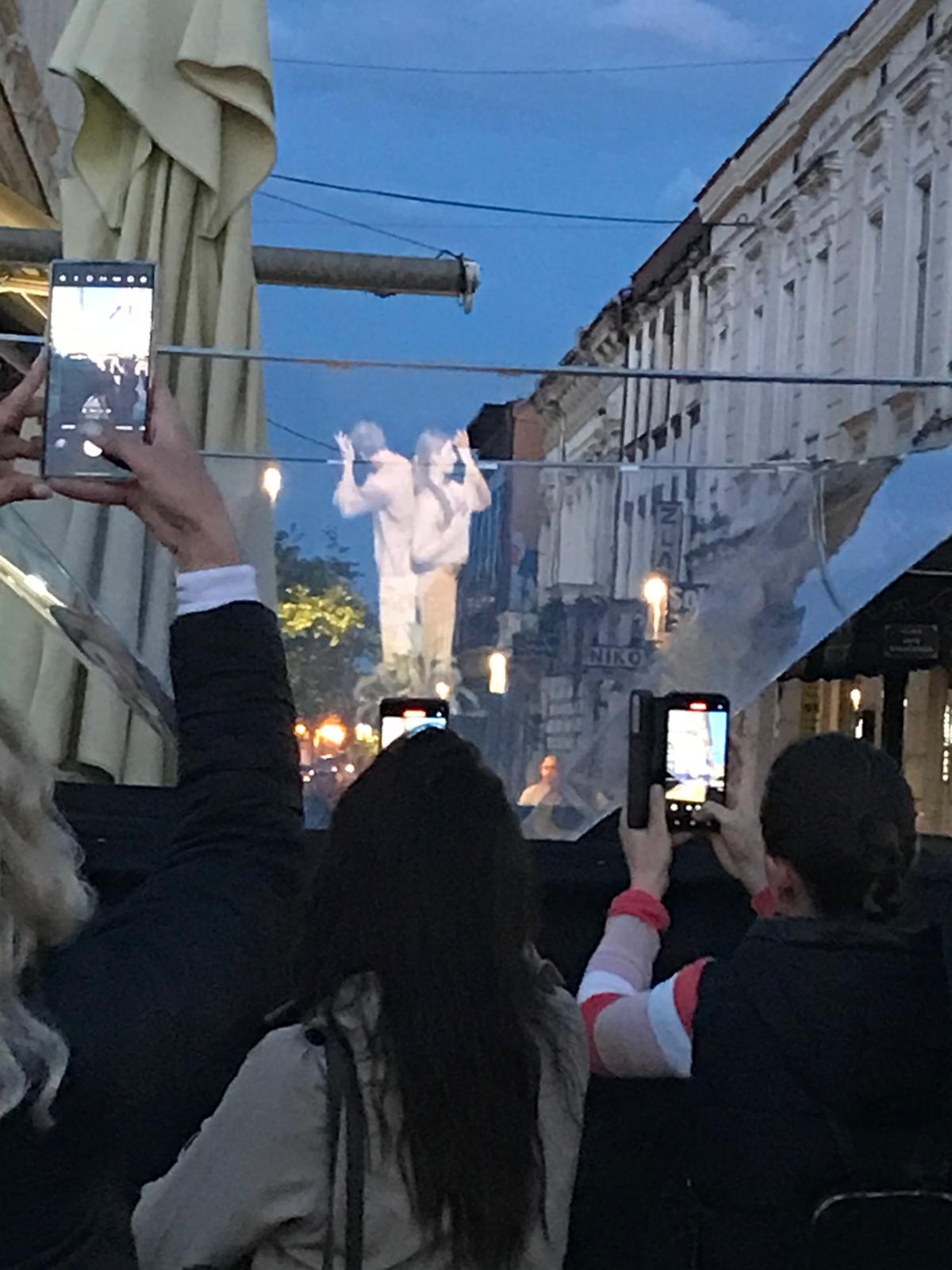
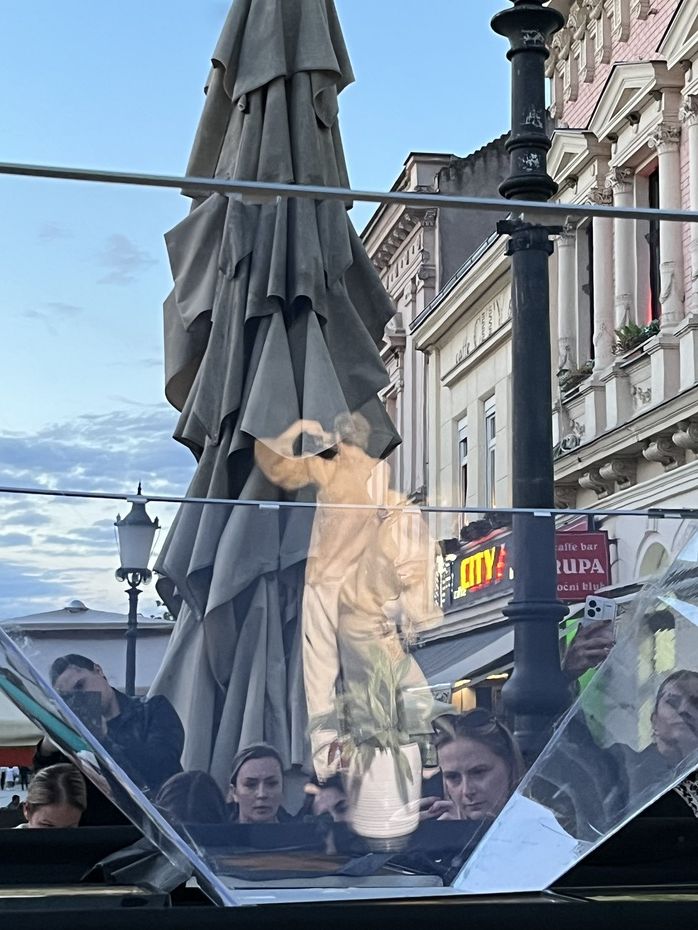
The project Hologram for plants and students: ADU & ARTHEA & UNISB (*Academy of Dramatic Art in Zagreb & NGO ARTHEA & University of Slavonski Brod) is presented as a performative event that uses the artistic metalanguage of media art, i.e. digital synesthetic framing with a hologram image, sound and the process of a recorded dance next to a sound-activated plant in the real space of the biosphere.

Back in 2011, the thesis of my doctoral dissertation Electronic media and aesthetics in post-feminist theory was that the aesthetic of media art becomes valuable through the performative, holistic and cybernetic in the domain of the Technosphere.

What is important, the spectacle is not the intention here, because we question whether the artistic event/performance notices us, to paraphrase the painter Paul Klee and media art theorist Žarko Paić (2019) – is there (astonished) biofeedback?

Žižek (2024) in his book Christian Atheism writes about Athings or Non-things as a new materialism of objects without aura, which do not have a discrete language of objects, that they are the real that escapes symbolic and quotes Han: The NON-THING impresses because it does not inform. It is the reverse, mysterious backyard, the ‘subtle beyond’ of the artwork, even its unconscious. It resists the disenchantment of art.

In this sense, our performative project transcends the banality of the spectacle of the Technosphere in a way that, through biofeedback from the audience, scientists, students and artists, and especially the plants, it is self-regulated through the loop of the (cybernetic) system, granting deep spiritual peace and a moment of tranquillity in which, as philosopher Marijan Cipra (1999) would say, Sisyphus’s rolling stone stops.

The lucid David Bowie, an English rock singer, also spoke about the unconscious levels of assimilation and humanization of technology through experimentation in inner worlds, in a famous interview (1999) with an interesting statement on technology (the Internet): … it is an alien lifeform – a technology that is both exciting and terrifying, we would say an area of ​​existential and spiritual transformations that are intensifying.

With this infinite loop of the present, we twist the past and the future, referring to Badiou, and through the performative event of authentic humanity, we contribute to the union in a higher organic unity – that of science and art through love, or to apply the moral code of Cipra (1999) from his Christocentric period to collision with the technology of transhumanism, in which he directs people to the revelation of the dialectical principle of the Apostle Paul in the New Testament: (…) we have been freed from the Law and serve in the newness of the Spirit, and not in the oldness of the letters.

Photo: Majda Jakšić, UniSB student

Photo: Valerija Filotas, UniSB student

Marta Vrtarić, UniSB student

Video: Danijela

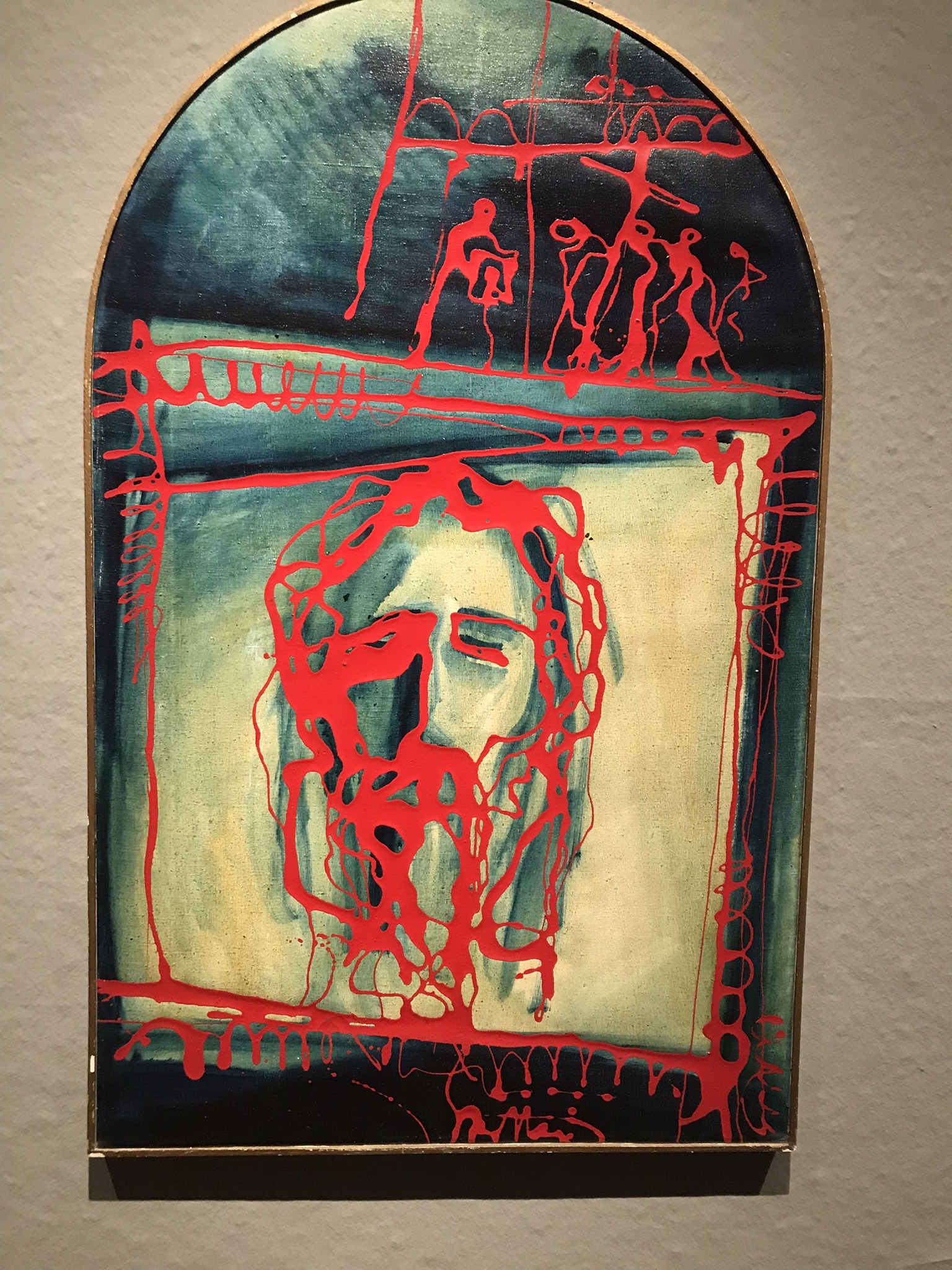
The recent exhibition of the Dalmatian painter Botteri Dini in Zagreb Klovićevi dvori (till 6.2.2024.) matches the quality of new controversial book by the world-famous Slovenian philosopher Slavoj Žižek, known in the West as “the most dangerous atheist and leftist”. But we think that Žižek’s preoccupation with Badiou’s concept of “the event” did not solve the process nor performativity in art.

“More than 100 public works by Josip Botteri Dini can be seen all over Croatia and the world, such as the stained-glass windows in the Church of the Holy Cross in Siget in Zagreb or the monumental frieze History of Split in Hotel Zagreb in Split. Monumental stained-glass windows and mosaics adorn the Church of St Leopold Bogdan Mandić in Melbourne, Australia, as do the stained glass, mosaic, and paintings in the Church of Christ the King in Porto D’Ascoli, Italy.

Contemplating the spirit of the times, he created a unique oeuvre within contemporary art, especially in the field of religious art, with recognizable and distinctive artistic interpretations of biblical content. It is precisely in this area that Josip Botteri Dini has a prominent place within domestic and international art.” (Josip Botteri Dini – A retrospective, Klovićevi dvori, Zagreb)

A unique insight of a theological project Christian Atheism, as a new book of worldly famous Slovenian philosopher Slavoj Žižek, brings us the exploration of his religious thinking: “This affirmation of Christian theology whilst simultaneously deconstructing it is familiar Žižekian move, but one that holds deep-seated political, philosophical and, in the end, personal import for him”. Boštjan Nedoh adds: (…) “Žižek makes it clear why Christian atheism is the main concept of every true materialism”. (Bloomsbury Academic)

But we think that Žižek’s preoccupation with Badiou’s concept of “the event” did not solve the process nor performativity in art.

PhD. Vesna Srnic, Media-Via president and editor

MV

Source:

https://gkd.hr/en/exibition/josip-botteri-dini-a-retrospective/

On Sunday evening (13th January, 2019) the moderator Srecko Horvat introduced at the Philosophical theater of the HNK (Croatian National Theater) in Zagreb, a famous Slovenian philosopher Dr Alenka Zupancic. Dr. Zupancic is close associate of worldly known Dr Slavoj Zizek and a writer of interesting book – What is Sex? published by the MIT Press.

One of the main ideas of the book What is Sex? is that sexuality is a short circuit between ontology and epistemology (being and knowledge).

Other important ideas:

  • “(..) but in a stronger sense of the gap in knowledge coinciding with the gap in being. We do not know, because there is nothing to know. Yet this “nothing” is inherent to being, and constitutes its irreducible crack; it registers as a peculiar (“negative”) epistemological score, it registers as a peculiar form of knowledge: the unconscious.” (p. 143)

  • „Whenever it comes to social, cultural, or religious covering up of sexuality, we can be sure that it never covers up simply what is there (for example, the sexual organs), but also (and perhaps primarily) something which is not there; it also covers up some fundamental ambiguity which is, from the outset, of a metaphysical order. In other words: the more we try to think the sexual as sexual (that is, the more we try to think it only for “what it is,” without censorship and embellishments), the quicker we find ourselves in the element of pure and profound metaphysics. This is why there is no “neutral” way to speak about sex—even if we pretend not to hide anything, and speak only of facts, something else seems to get added, or to disappear.“ … (p. 141)


  • To paraphrase, Lacan thinks that in a „Gap“ of actuality, between conscious and unconscious, reality is triggered to become politics … Badiou says that in the situational “Gap” cracking Event should happen or perhaps revolution, so discourse begins to evaluate and becomes Real being as a “wandering surplus” or “surplus jouissance”. Lacan disagrees – it is not a real being but a “symptom”…


  • “Materialism would thus mean, in this account: the reality minus the illusion which accompanies it and keeps transforming it into something quite different.” (p. 120)
  • “The (Lacanian) subject is not simply the one who thinks, it is also and above all what makes certain contradictions accessible to thought; it is the way in which these contradictions appear as a “matter of thought.” (p. 122)
  • “To think a paradox or contradiction does not mean to stare at it with fascination, as in a kind of mystical revelation of the Absolute; it means precisely what it says—to think it.” (p. 123)
  • So perhaps this would be a good formulation of materialism: materialism is thinking which advances as thinking of contradictions.


Due to the timing problems, the president of the NGO Arthea association dr. Srnic did not ask this question, but she kindly puts it now:

You discussed about „animal“ and „human“ in your book … But can you explain or define the position of sexuality between a man/woman and a Hologram? Recently, a marriage between a young man and a Hologram occurred in Japan … So, what about the enjoyment or jouissance here?

You mentioned dreaming and „piloting the Animal“, but can we pilot the Hologram which is the most of virtual reality we can produce so far?! Is this relation „Real“ or just a „Dream“?! You said: “(…) every drive is virtually a death drive”, so is this correlation between Real and Virtual actually a correlation between Life and Death or a sort of anthropological „Television of the Forest“ (Narby)…

PHD. ALENKA ZUPANCIC ANSWERED TO THE MEDIA-VIA.NET PORTAL:

Thank you very much for your questions. They are related, they both involve the hologram as the other in a relationship. So I will take them together. The issue is big, and involves many different facets which I cannot possible deal with here, so let me just propose a few thoughts.

There is something about this story of “man marries a hologram” that is very old. We can take an example that is exactly 100 years old: Ernest’s Lubitsch’s film Die Puppe (The Doll) tells a story of a man who has to marry because otherwise he would lose his inheritance, but doesn’t want all the relationship-things that marriage implies. So he orders a mechanical doll which is a perfect replica of the doll-maker’s daughter. Things get complicated because the doll breaks down and the real daughter steps in pretending to be a doll… But anyway, the basic idea is something like this: by replacing a real partner with an artificial one we can get a perfect partner, attending to all our needs, but without the fuss that comes with a real relationship. The idea is not new, but became particularly present with rapid technological development and new possibilities it seems to offer. But according to Lacan this is precisely how most of the ordinary relationships function, particularly so far as men are concerned, and on an even more fundamental level. It’s not simply the question of eliminating the fuss, but more fundamentally the question of relating: do we really relate to the other as other when we are in a relationship, or is the other rather the screen or object via which we relate to ourselves, and that we need to be able to enjoy? Or, to use even more vivid language proposed by Slavoj Žižek: if masturbation is defined as “having sex with an imaginary partner”, then perhaps sexual intercourse could be defined in many cases as “masturbating with a real partner”. Or, as Woody Allen put it in anther turn of this same screw: “Masturbating is having sex with somebody you really love”. In other words, perhaps we don’t realize to what extent we already are functioning in relationships as holograms of our partners. Imperfect ones, and here technology can indeed step in and eliminate us altogether. Of course things change when this actually happens, and we can effectively, empirically eliminate the other as Other. But still, the structure at the bottom of this particular example is an old and absolutely pre-technological story of human sexuality and relationships. Then there is also the question – which many SF stories play with – of what happens if this technological gadgets actually do become our Other, in an most emphatic sense: if they gain autonomy (from our mastery), if they impose a rule of their own, if they enslave us to whatever “new order” they represent…


PhD. Vesna Srnic, Research Fellow (text, photographs, video)

MV

International Interdisciplinary Symposium PHILOSOPHY OF MEDIA – Issues of founding, establishing and/or revelation,  will be held on the Croatian island Cres between 16-18 September, 2011. Media-via portal editor M.A. Vesna Srnic is invited to present her papers “Glocal Multimedia Art” at the symposium, organised in the year in which we celebrate the centenary of the  birth of Marshall McLuhan.

In front of Program comitee PhD. Divna Vuksanovic (Serbia) and PhD. Sead Alic (Croatia) stressed: “We live in a time of media intercession, networking, virtual worlds, a growing impact of mass media on politics, culture, human life, experience, or even opinions as such. We exist in a time when the immersion into the world of the mass media reminds us of the fact that we as human beings throughout history have been determined by some sort of media and that only the modern preoccupation with the (mass) media has given rise to an awareness of (partial or total) oblivion of media intercession,especially during times of oral communication, written and print form.” (…)   “In this sense, the philosophy of media co-opts the scientific research of linguistics, psycholinguistics, media theory, the theory of special art, knowledge of techniques and technologies, research psychology, medicine, phonetics, cultural and visual studies, and other science disciplines, theoretical knowledge and practice experience.” tENrNp4O_ZE

Symposium sponsors are  Ministry of Science, Education and Sports of the Republic of Croatia, Croatian National Tourist Board, Town of Cres and Hotel Kimen Cres.

This slideshow requires JavaScript.

MV

Source:

Programme of Symposium